
Blog · Analysis
Same engine, see it as different cars: why Harness reviews are so split
August 25, 2026 · dshbase · reception analysis
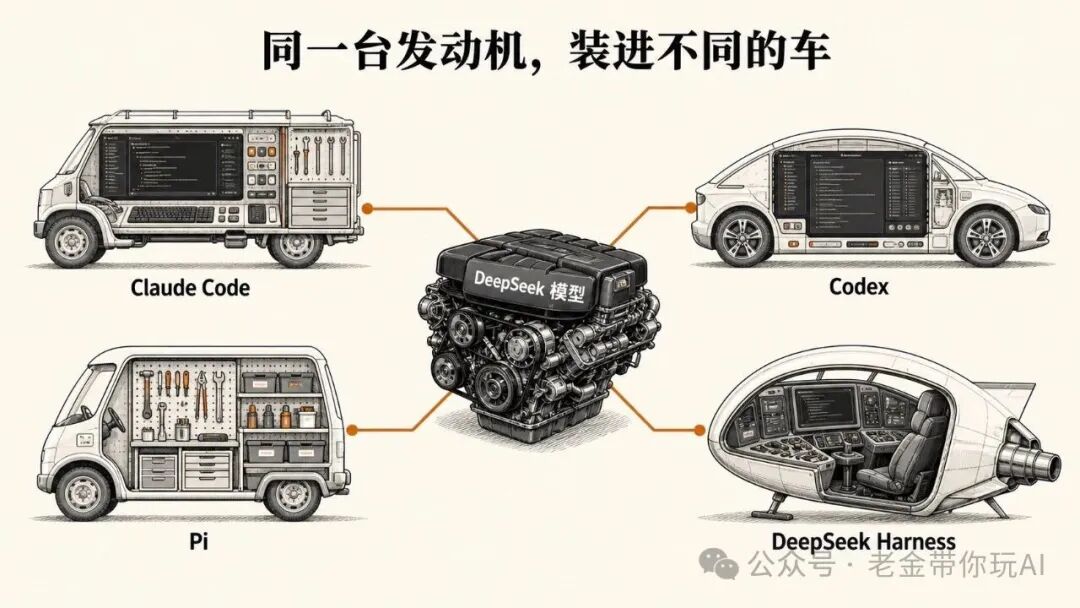
Over the first week, reception of DeepSeek Harness fractured in a telling way. Domestic reviews tend to say it's slow, burns tokens, and isn't intuitive. Overseas developers, meanwhile, have been tearing into the architecture — modifying plugins, swapping out the Agent Loop, building on it. Before a feature got fixed, the mood already shifted. Why?
The two yardsticks disagree on purpose
An ordinary user asks one question: can I finish today's work with this? — code faster, understand better, don't flake out. On that scale, a developer-preview harness genuinely doesn't dominate, and nobody pretends otherwise. A developer asks a second question the user never does: how far down can I actually change this? The moment you start pulling at the layers, the frame flips — models, skills, sessions, sandboxes, storage, scheduling, the UI, even the Agent Loop are replaceable and recomposable. The user sees "why isn't this as smooth as Codex yet"; the developer sees "I can rebuild even this part."
So the real split isn't between east and west. It's between people who want a trained employee that shows up and works, and people who want a company base where they hire, equip and define their own process. Both are correct — one is judging the finished product, the other is studying how the product is made.
What a harness actually is
We habitually credit the model with everything, but a model is just a very smart brain. It doesn't inherently know where your project lives, and it has no natural access to a terminal, browser, database, memory or file permissions. The layer that wires those to the model and decides when it looks at what, calls what, and retries on failure is the harness. The formula is direct: Agent = Model + Harness. The same smart employee performs very differently depending on the company's processes — and the same DeepSeek model behaves very differently inside different harnesses, because tools, context and the task loop differ.
The radical part: even the "core" is built to be replaced
Open-sourcing isn't itself surprising. What stands out is the depth. With everything-is-a-plugin, the model adapter, the tool registry, the session log and the Agent Loop — things most products treat as untouchable infrastructure — are configurable, replaceable components. There is no privileged core you must keep. Underneath, a kernel called Cordis handles mounting, unmounting and dependency resolution so agent capabilities compose like building blocks instead of falling apart when you pull one.
Paired with that is traceability. Each run can be followed end to end: system prompts, context injection, tool calls and subagent scheduling all land in an append-only session log, and the Trajectory view shows the exact step where things veered off. The agent stops being a black box you can only stare at.
Why the overseas mood shifted
The reviews that moved the needle are the mixed, believable ones: yes, it's slow and token-hungry and the docs are rough, but it squeezes DeepSeek's performance fully and cache-hit rates reach ~99%; some like the UI and the code-composing mode while admitting subagent support is still rough. Contradictory-sounding, but that's what genuine usage looks like. What changed wasn't one fixed feature — it was the framing settling in: DeepSeek may be competing less for the coding-agent crown than for the definition of what an agent is. Judge it as a finished tool today and you'll be underwhelmed; judge it as a foundation for building your own agent stack and you're likely judging too early.