
Blog · Review
121,767 stars, six axes: an honest health check
August 25, 2026 · dshbase · deep-dive review
Day three after launch, the repository sat at 121,767 stars (12,007 forks, MIT license). One reviewer spent a full day on a real machine — macOS, Node 22.19, dsh 0.1.0-rc.6 — tearing apart the install package, running performance checks, verifying security findings in an isolated environment, decompressing real session logs, and auditing six of the most-downloaded plugins. The verdict: architecture openness and observability are genuine highlights; the plugin security model and ecosystem maturity are genuine weaknesses.
Architecture: the modularity is real
dsh itself has 61 direct dependencies, 36 of them official @deepseek-ai packages, each doing one thing — 12 tool packages, 9 capability packages, 7 environment packages, 8 scheduling packages, 2 UI packages. Don't need PowerShell? Skip dsh-pwsh-* and save size and attack surface. "Everything is a plugin" is delivered at the packaging level, not just proclaimed.
Underneath sits Cordis: plugins are Fiber state machines, activation waits on dependencies, and every context mutation is registered through ctx.effect() with a returned undo function — unload runs disposables in reverse, so plugin removal is a complete reversal. That reversibility is what makes hot reload and "the agent modifying its own harness" plausible rather than marketing.
Performance and observability: best-in-class bits
Cold start measured ~60 ms; dsh --dump-config returns in ~0.19 s (526 lines). The sleeper hit is observability: real session logs at ~/.dsh/sessions/*.zstd are compressed JSONL with ~7,000 events across 13 types per session — reasoning chunks (3,023), assistant chunks (1,714), tool-call chunks (987), tool calls/results (190/190) — plus request metadata (provider, model, maxTokens) and the logged 1M-token context. What the model saw, which tool it called, how tokens moved: all replayable. That granularity is rare in agent tooling.
Security: two very different stories
Axis A — the agent runtime itself: serious. Approvals, sandboxing, audit trails and anti-obfuscation all held up in verified tests (8/10). Axis B — plugin code: no guardrails. Plugins run inside the host process with host permissions; install/update/persist/hot-reload paths carry no signing, no integrity checks, no source verification, no confirmation gate. Demonstrated attack surface includes !!js config-to-RCE, malicious bundles executing at install time, zero post-install tamper checks, plugin remove leaving persisted backdoors behind, ~15 s hot-reload weaponization via telemetry, and an unauthenticated loopback RPC that can read the full session. One more practical gotcha: dsh --dump-config prints plaintext API keys/env — a screenshot of that output is a credential leak.
In short: the runtime's own security model is thoughtful; the plugin supply chain assumes good faith. Before installing any third-party plugin, assume it may be reading your data. The official mitigations (pnpm integrity, 0600/0700 permissions, .env protection, privileged-RPC loopback binding) are real but don't stop a malicious plugin.
Ecosystem: hot at the head, weird at the tail
Live numbers at review time: dsh-web-ui-all (weekly downloads 11,175, 2,964 stars), dshmarket (11,862 downloads, 20 versions in 2 days), dsh-better-sidebar (7,486 downloads, 1,413 stars, best README), dsh-pocket (4,381 downloads but 4 stars and 37 versions in a day — a suspicious combination), dsh-web-plugin-manager (2,788), dsh-find-plugin (1,198, stalled). Install test of the flagship bundle: 13 subpackages / 37 MB resolved fine, then hung for 5 minutes on the cloudflared postinstall binary download before timing out — your first real churn point.
Scorecard and the honest bottom line
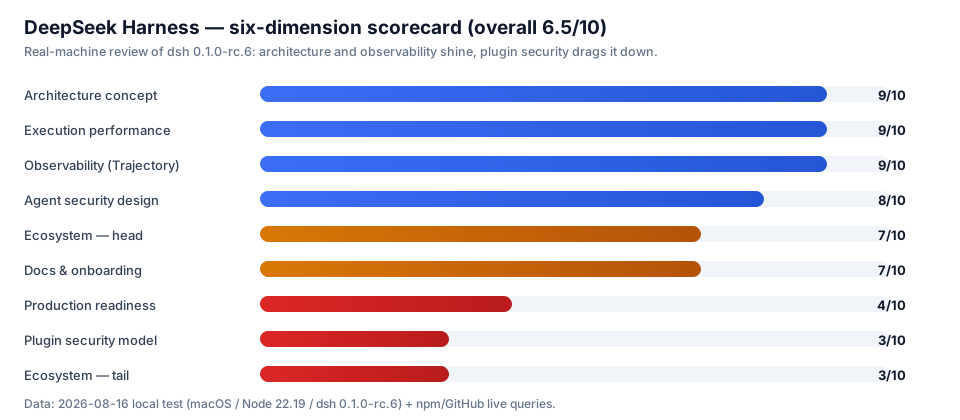
- Architecture concept 9/10 · Execution performance 9/10 · Observability 9/10 · Agent security design 8/10
- Plugin security model 3/10 · Ecosystem head 7/10 · Ecosystem tail 3/10 · Docs & onboarding 7/10 · Production readiness 4/10
- Overall: 6.5/10.
Five expectations worth discarding: don't treat third-party plugins as trusted components; don't expect stable APIs (17 versions in 3 days); check licenses per package (MIT/Apache-2.0/GPL-2.0 mix); don't expect frictionless installs (cloudflared is the first snag); and don't put preview software on production or sensitive workloads. Great for architecture study and experimentation — that's exactly what a 0.1.0-rc is for.