
cocode
已验证 · 实测可装 cocode-agency
功能简介
Best ready-to-run DeepSeek Harness distribution: DSH desktop GUI, terminal TUI, and harness integration.
推荐 — 实测可用且热门
Best ready-to-run DeepSeek Harness distribution: DSH desktop GUI, terminal TUI, and harness integration. 实测能干净安装、正常启动。163+ stars,社区认可度高,是低风险选择。
「已验证」表示我们的自动化 CI 在干净 profile 里实际执行了 dsh plugin add 并启动成功——仅此而已。功能描述与版本兼容性均为作者声明。这不是安全审计,也不代表对第三方代码的背书。
README
Cocode
A ready-to-run DeepSeek Harness distribution.

Most coding agents make the choices for you and take the choice away with them:
which tools are available, how work gets scheduled, what the interface looks
like — all settled upstream. Cocode wants the other half of that bargain. It
makes the choices for you and leaves the screwdriver within reach: the default
setup works the moment you install it, with nothing to study first, and when it
doesn't fit you can open it up, see exactly how it was put together, and change
it to your liking. Everything else in Cocode follows from that.
The runtime underneath is DeepSeek Harness, which makes an argument of its own:
everything is a plugin. Models, tools, skills, sessions, sandboxes, and
scheduling all come together through configuration, and Harness takes no
position on what you should assemble. Cocode assembles one of those, and puts
the assembly out in the open in the product instead of burying it in a config
file.
Project status: Developer preview. Cocode is built on the DeepSeek Harness
developer preview. It is an independent distribution, not an official DeepSeek
product, and upstream compatibility may change. The repository supports source
builds on macOS, Windows, and Linux; the current release scripts target macOS
and Windows artifacts, and this repository does not include a hosted backend or
a vendored Harness checkout.
Install and try it in five minutes
| Use case | Install | Start |
|---|---|---|
| GUI | Download the installer for your platform from the GitHub Releases page. | Launch Cocode, then choose Cocode Pro with hosted Nut credits or your own DeepSeek-compatible key. |
| TUI | Node.js 22.19.x or later (24+ is also supported), then npm install --global @cocode-agency/tui. |
Run cocode doctor, then cocode. A real terminal is required. |
| From source | Follow the component-specific pnpm instructions below. | Use make dev gui or make dev tui. |
The published TUI package installs the matching @cocode-agency/host-supervisor
automatically. For every release, keep @cocode-agency/tui and@cocode-agency/host-supervisor on the same version line; do not mix versions from
different releases. GUI installers are downloaded separately from the matching
GitHub Release and are not installed through npm. The current repository is a
developer preview, so release availability and upstream Harness compatibility
can change.
Five-minute first run
- Install the GUI from GitHub Releases, or run
npm install --global @cocode-agency/tui. - Start the GUI, or run
cocode doctorfollowed bycocodein a real TTY. - Choose Cocode Pro / Cocode Nut, or enter your own DeepSeek-compatible API key.
- Open a workspace and ask the agent to inspect a file or explain the project.
- If startup fails, save the output of
cocode doctorandcocode host status --jsonfor troubleshooting. Remove credentials and
private session data before sharing diagnostics.
Why Cocode
The agent itself comes apart. Which tools a session runs, what prompts it
carries, which capabilities are on — that is a plugin assembly called a preset,
and you can read its agent.cordis.yml right in the interface. Four presets
ship built in — Standard, PTC, Minimal, and Creator — and you copy one to make
it yours. Elsewhere you get to swap the model. Here you get to swap the agent.
A workspace, not a chat box. Files, Git, a terminal, a built-in browser, and
diff previews sit alongside the session. What the agent changed and what it ran
is right there next to you, and you can take over by hand at any point instead
of carrying context between windows.
The desktop and the terminal pick up the same session. GUI and TUI connect
to the same Host and read and write the same session record. Push a task forward
at your desk, then SSH in and continue from the terminal — presentation state
never enters the session log, so any client can rebuild the full conversation
from it.
The model is your call too. An official DeepSeek key, any OpenAI-compatible
self-hosted or gateway endpoint, or Cocode Pro's hosted Cocode Nut service — all
three are available, and you can switch between them.
Cocode is not trying to be another chat window. It won't parade a full chain of
thought at you as a feature, and it won't hand the model every tool by default.
What it wants to be is a workspace you trust with real work — and one you can
reshape to your own liking.
Two entry points, one session
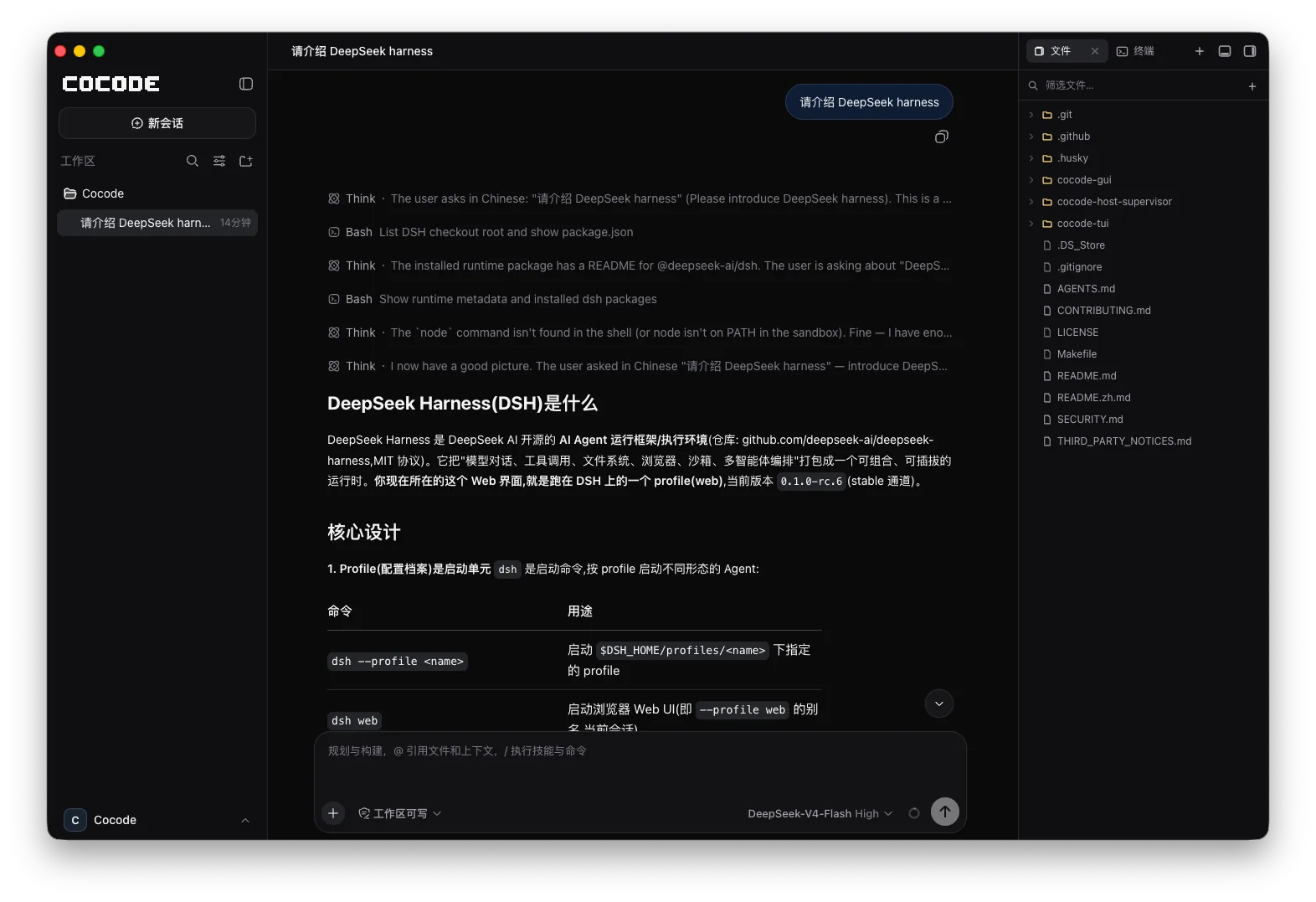
| Cocode GUI | A desktop workspace built on Electron. Sessions, files, terminals, and runtime state live on one surface. Diffs and attachments open in a preview panel, so you see exactly what changed before you confirm. |
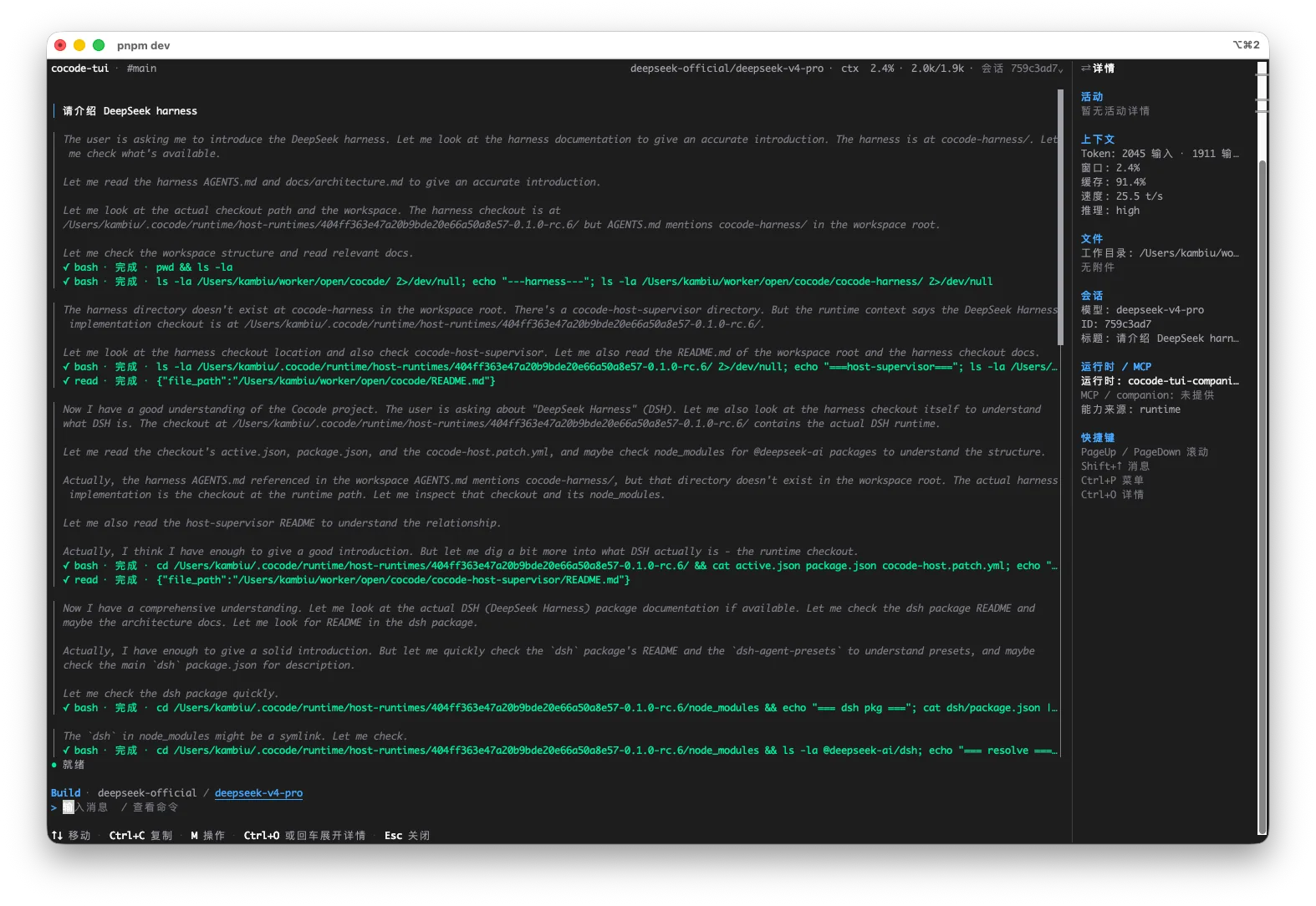
| Cocode TUI | A terminal client for keyboard-first and remote work. SSH into a machine and keep pushing tasks with no graphical environment required. |
Both attach to the same Host through @cocode-agency/host-supervisor, so they can share
sessions and task state when they use the same DSH_HOME, profile, and Host
configuration scope. Switching between the desktop app and the terminal does
not reset your work within that scope.
Cocode GUI
Cocode TUI
Repository layout
This repository is not a single workspace. Each component is an independent
pnpm workspace with its own lockfile and toolchain, tied together by a rootMakefile.
cocode/
├── cocode-gui/               # Electron desktop / web GUI  (@cocode/gui-root)
├── cocode-tui/               # Terminal client             (@cocode-agency/tui)
├── cocode-host-supervisor/   # Shared DSH Host lifecycle   (@cocode-agency/host-supervisor)
├── Makefile                  # Root dev shortcuts
└── AGENTS.md                 # Engineering contract for contributors and agents
The runtime itself is not vendored here. @cocode-agency/host-supervisor pins@deepseek-ai/dsh from npm and owns the Supervisor service, the local IPC and
lease protocol, runtime-slot materialization, and the Cocode JSON-RPC Host
plugin. GUI and TUI never launch a Harness process themselves — they acquire a
lease for a canonical DSH_HOME + profile + Host configuration scope and connect
to the endpoint the Host advertises.
Cocode GUI ─┐
            ├─→ @cocode-agency/host-supervisor ─→ @deepseek-ai/dsh (npm) ─→ models · tools · sessions
Cocode TUI ─┘
Upgrading DSH
DSH is released as one exact release train in Cocode. The canonical target iscocode-host-supervisor/package.json's @deepseek-ai/dsh dependency; the GUI
client packages and every packages/cocode/* plugin peer dependency must use
that same version.
After changing the DSH package versions and refreshing both lockfiles, run the
fast contract check first:
cd cocode-gui
corepack [email protected] install --frozen-lockfile --ignore-scripts
corepack [email protected] run check:dsh-contract
It checks all DSH declarations, installed package manifests, Cocode plugin
manifests, browser plugin entrypoints, and every dsh.client.inject target.
The complete gate rebuilds the plugins and Electron app, runs GUI/Host tests,
stages a clean npm DSH runtime, and verifies its closure and hashes:
corepack [email protected] run check:dsh-compatibility
Do not treat a successful TypeScript build alone as compatibility proof. A DSH
upgrade can change slot names, plugin injection, exported client entrypoints,
or runtime dependency closure; the clean staging and runtime verification are
what catch those integration breaks before release.
Requirements
The three components do not share a toolchain baseline. Check the one you plan
to build:
| Component | Node.js | pnpm |
|---|---|---|
cocode-gui |
>=22.12.0 (see .nvmrc) |
10.34.5 exactly |
cocode-tui |
^22.19 or >=24 |
any recent version |
cocode-host-supervisor |
>=22.12.0 |
any recent version |
Getting started
Every target below runs from the repository root.
# Desktop workspace: Electron client + Vite on :5273
make install-gui
make dev gui

# Terminal client (requires a TTY; preflight installs deps and refreshes the Host runtime)
make install-tui
make dev tui

# Browser-only GUI, useful for design-system work
make dev gui-web

# The Host on its own, for wire-protocol debugging
make install-dsh
make dev dsh
Run make with no arguments to list every target.
The cocode command
After installing the TUI or desktop build, cocode is the unified entry point. With no subcommand it keeps the existing behavior and opens the TUI. GUI, TUI, and Host management use the same environment-derived Host scope, so different clients can attach to the same Host.
cocode version                   # Show Cocode and bundled DSH versions
cocode --version                 # Print the installed Cocode version
cocode gui                       # Open the GUI
cocode tui                       # Open the TUI
cocode plugin list               # List plugins in the default cocode profile
cocode plugin --profile web list # List plugins in a selected DSH profile
cocode host status               # Inspect the shared Host without starting it
cocode host status --json        # Print machine-readable status
cocode host stop                 # Stop Host and Supervisor when no clients hold leases
cocode host stop --force         # Explicitly interrupt GUI/TUI clients that hold leases
cocode doctor                    # Check TUI, Supervisor, and Host connectivity
--dsh-home <path>, --profile <name>, and --runtime-channel stable|preview|dev can be placed before or after a subcommand to select the Host scope. If the GUI cannot be located automatically on a platform, set COCODE_GUI_EXECUTABLE (or the COCODE_GUI_PATH alias) to its executable path.
The GUI reuses a staged runtime in the OS cache directory. Two escape hatches
when that cache goes stale:
DSH_FORCE_RESTAGE=1 make dev gui        # refresh the cache
DSH_DISABLE_RUNTIME_CACHE=1 make dev gui  # isolated runtime, no cache
Building distributables
make gui-build # Electron Forge installers for the current platform
The canonical GUI release command is parameterized by platform and architecture:
cd cocode-gui
corepack [email protected] run release -- --platform darwin --arch arm64
The legacy release:<platform>:<arch> commands remain as compatibility aliases
for existing automation.
The GUI is a private Electron workspace rather than an npm application package.
The TUI and Host Supervisor have public publish configuration, but registry
installation should only use matching versions listed in the same GitHub
Release and npm release.
Getting a model
Cocode does not bundle a model and is not tied to one vendor. On first launch it
asks you exactly one thing: use Cocode Pro with hosted Cocode Nut, or use your
own key. Both can live on the same machine, and you can switch at any time.
Cocode Pro: subscription
Cocode Pro is the subscription plan for the Cocode GUI and TUI. It provides
cycle-based Nut model credits, curated model access, paid-call priority, and one
place to manage usage, billing, and automatic recharge. Cycle credits expire at
period end; separately purchased Nut top-ups do not expire.
Cocode Nut: no API key to apply for
Cocode Nut is the hosted model service available with Cocode Pro. Sign in and
call models through the desktop workspace, terminal, or an OpenAI-compatible
personal API key — no upstream key to apply for or rotate.
- There's a free tier, so you can just try it. No payment up front; decide
about more credits after it works in your real workflow. - Cocode Pro starts at $10 a month, for up to $60 worth of model usage. How far that goes depends
on which model you call; it is not a fixed amount. Models run on our own B300
cluster with no third-party resale, so the same money goes noticeably further. - DeepSeek V4 Pro and V4 Flash. The free tier is Flash only; paid tiers can
call both. - One balance across both entry points. The desktop workspace and the
terminal draw from the same credits, so there is nothing to manage separately. - Your code is not used for training. Prompts, code, and model responses are
not used for training or sold to third parties, and request content is not
retained beyond completing the call, billing, and necessary troubleshooting.
Current Cocode Pro plans live at cocode.agency/pro;
model endpoints and pricing live at cocode.agency/nut.
Upgrade or cancel at any time.
Identity tokens are stored in account.yaml under ~/.cocode, and the personal
inference key is owned by the Host credentials service. Neither enters the
session log.
Your own key
If you already have a DeepSeek API key, paste it on first launch. Cocode is a
DeepSeek Harness distribution, so running entirely locally comes with no strings
attached. The key is stored in the DSH credentials file under $DSH_HOME and
likewise never enters the session log.
Relevant environment variables: DSH_HOME and DSH_PROFILE select the shared
Host scope, COCODE_HOST_CONFIG_FINGERPRINT pins a custom Host composition,COCODE_HOME isolates Cocode credentials, and DSH_SESSION_ROOT relocates
session files.
Documentation
CONTRIBUTING.md |
Contribution workflow, checks, and change boundaries |
SECURITY.md |
Vulnerability reporting process |
cocode-tui/docs/ |
TUI user guides, in English and Chinese |
cocode-host-supervisor/README.md |
Supervisor lease protocol and client API |
cocode-gui/README.md |
GUI development, packaging, and update behavior |
THIRD_PARTY_NOTICES.md |
Third-party sources and license notices |
Product documentation lives at doc.cocode.agency.
Contributing
Read CONTRIBUTING.md first — it covers the commit convention,
which checks are mandatory, and how changes are scoped across the three
components. Please keep changes focused on the component they affect and avoid
committing local runtimes, caches, credentials, or generated output.
To report a security vulnerability, follow SECURITY.md rather than
opening a public issue.
License
MIT © 2026 Cocode Agency.
Third-party components, including the npm-delivered DeepSeek Harness and Cordis
framework, keep their own licenses. See
THIRD_PARTY_NOTICES.md.
cocode.agency · Documentation · Download · Cocode Pro · Cocode Nut
安装
装一次目录插件,之后本站所有插件都能让 DeepSeek Harness 自动找、自动装:
dsh plugin add dshbase-catalog然后对 agent 说「帮我装 cocode」,它会在目录里找到并自动安装。文档:dshbase-catalog · 已验证场景包。
该插件是 GitHub 源码(未发 npm)——直接从仓库装:
Web profile:
dsh plugin --profile web add github:cocode-agency/cocodeHeadless(CLI)profile:
dsh plugin --profile headless add github:cocode-agency/cocode实测报告
验证通过:从 GitHub 源码完成 L1 安装 + L2 加载 + L3 运行(dsh 0.1.0-rc.6)。
分享徽章
把这枚徽章粘进 README——它会链回本页,实测状态变化时自动更新:

[](https://dshbase.com/zh/plugins/cocode/)<a href="https://dshbase.com/zh/plugins/cocode/"><img src="https://dshbase.com/badges/cocode.svg" alt="dshbase 实测可装"></a>