
插件目录 / Automation / dsh-plannotator
dsh-plannotator
已验证 · 实测可装 titanwings
功能简介
DSH 计划批注插件:选中计划原文、逐条批注,并把结构化反馈送回 Agent。
可用 — 实测通过,早期项目
DSH 计划批注插件:选中计划原文、逐条批注,并把结构化反馈送回 Agent。 实测能干净安装、正常启动。早期项目,但功能可用。
「已验证」表示我们的自动化 CI 在干净 profile 里实际执行了 dsh plugin add 并启动成功——仅此而已。功能描述与版本兼容性均为作者声明。这不是安全审计,也不代表对第三方代码的背书。
README
📝 dsh-plannotator
Review the plan before your coding agent writes the code.



|
① The plan sounds plausible, but one sentence hides a migration risk? ② You found several independent problems, but the only choices are Approve or Reject? ③ You want every comment to stay attached to the exact text the agent must revise? |
✨ Turn a binary plan gate into a precise, multi-comment review.
Select exact plan text, collect precise comments, and return one structured review—without leaving DeepSeek Harness.
Why it exists · Features · Install · How it works
English · 简体中文
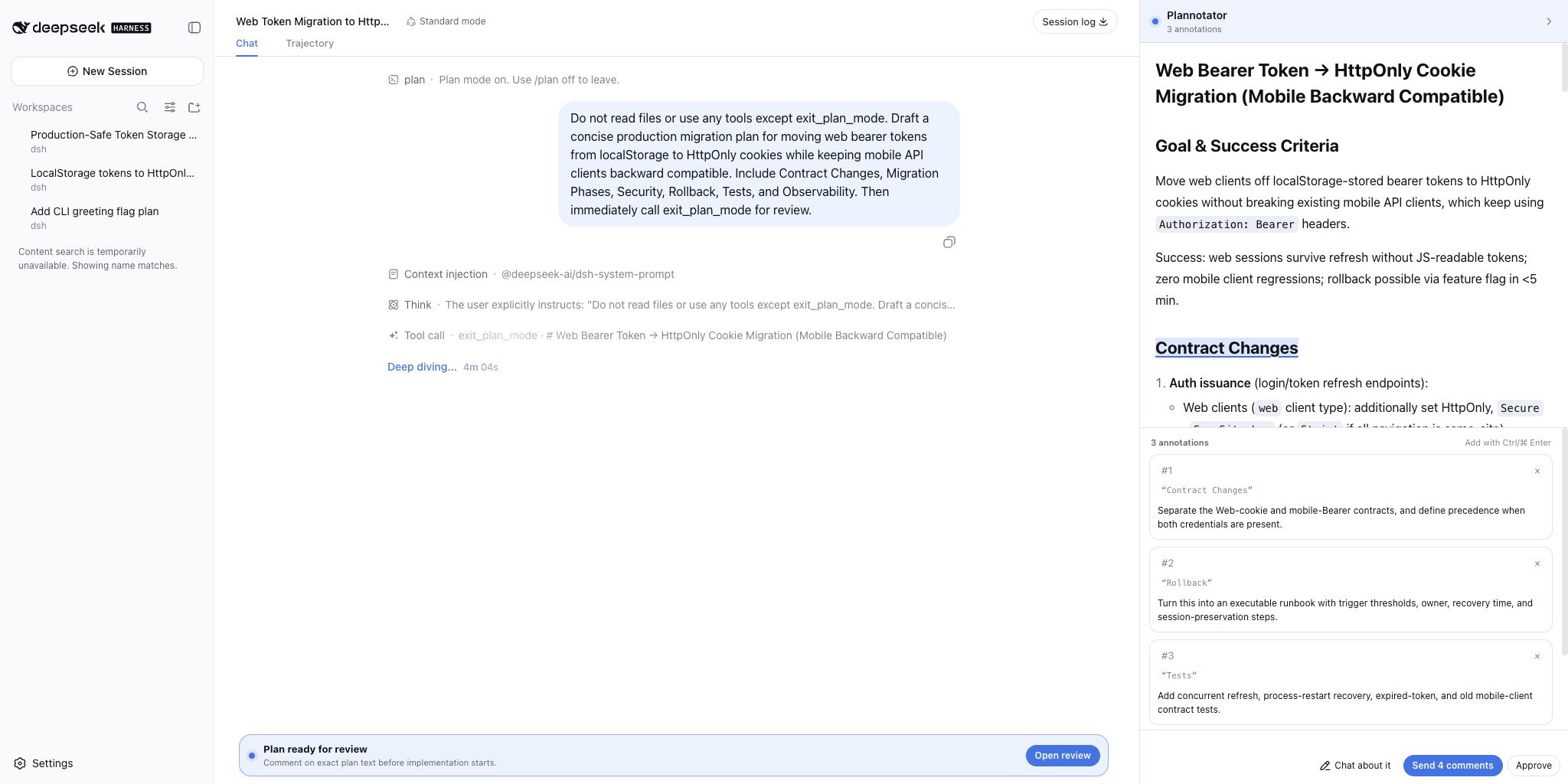
“Change the third step” is vague. A comment attached to the exact sentence
preserves the context the agent needs to revise the plan correctly.
Select exact text → comment on several risks → send one review → approve when ready.
🎯 Why dsh-plannotator
Coding agents are good at producing plans, but a binary Approve / Reject
decision is too coarse for serious work. Architecture migrations, API changes,
security fixes, and rollout plans often need several independent corrections
before implementation begins.
dsh-plannotator turns DSH's native Plan Review into a compact gate plus a
responsive companion panel. On a wide screen, the conversation and review
occupy separate columns, so opening the panel never covers chat text. Collapse
it to a slim edge rail and reopen it without settling the request. Your comments
still travel through DSH's existing response flow as structured Markdown, so the
agent can revise the proposal in plan mode and ask for review again.
This is an unofficial integration inspired by
Plannotator.
🧰 Features
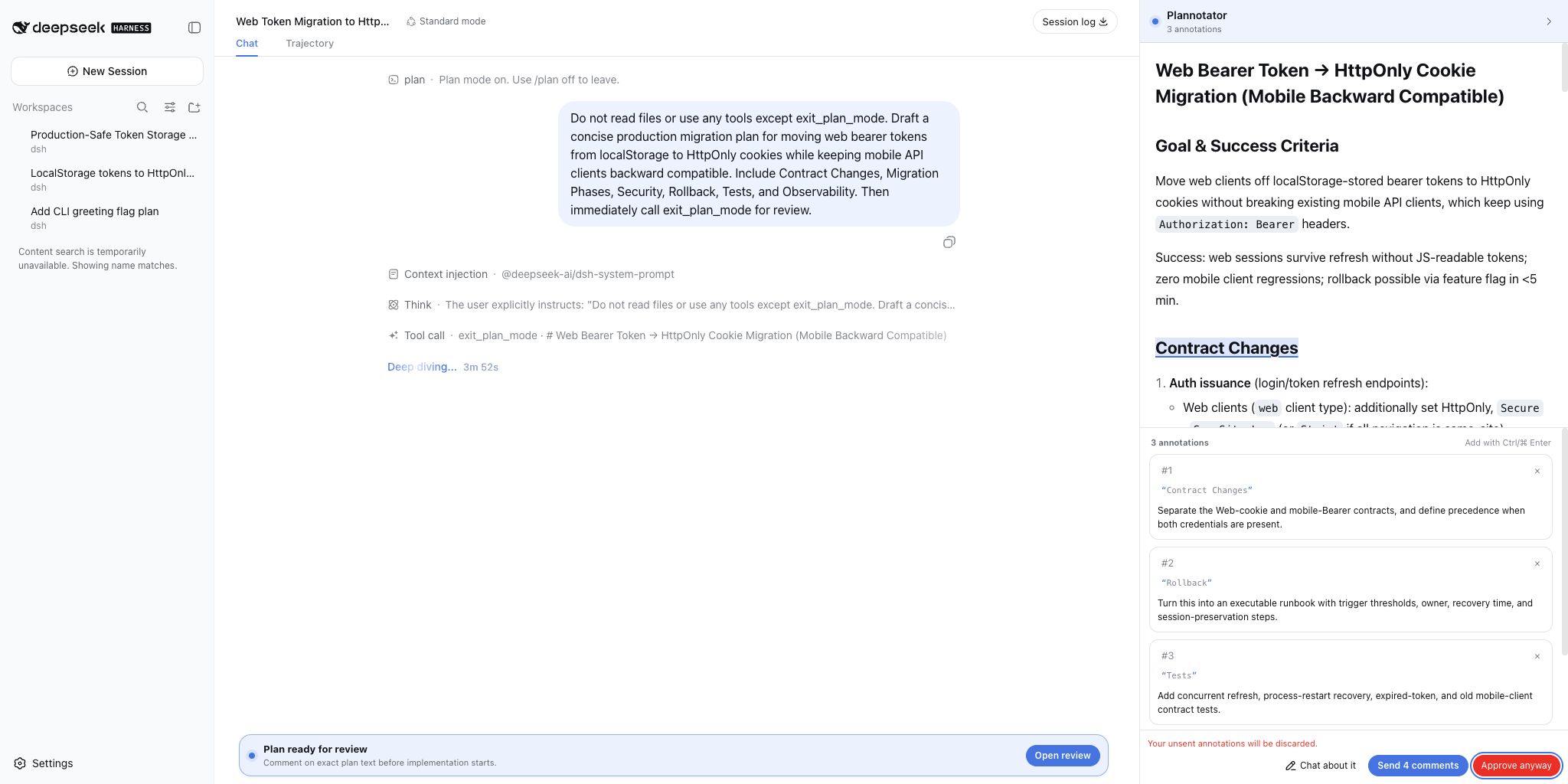
Comment on the exact claim—not “somewhere in the plan”
Drag over text for a precise annotation, or double-click a paragraph, list
item, heading, bold phrase, or code fragment. The review keeps the quote and
comment together within the current plan revision.
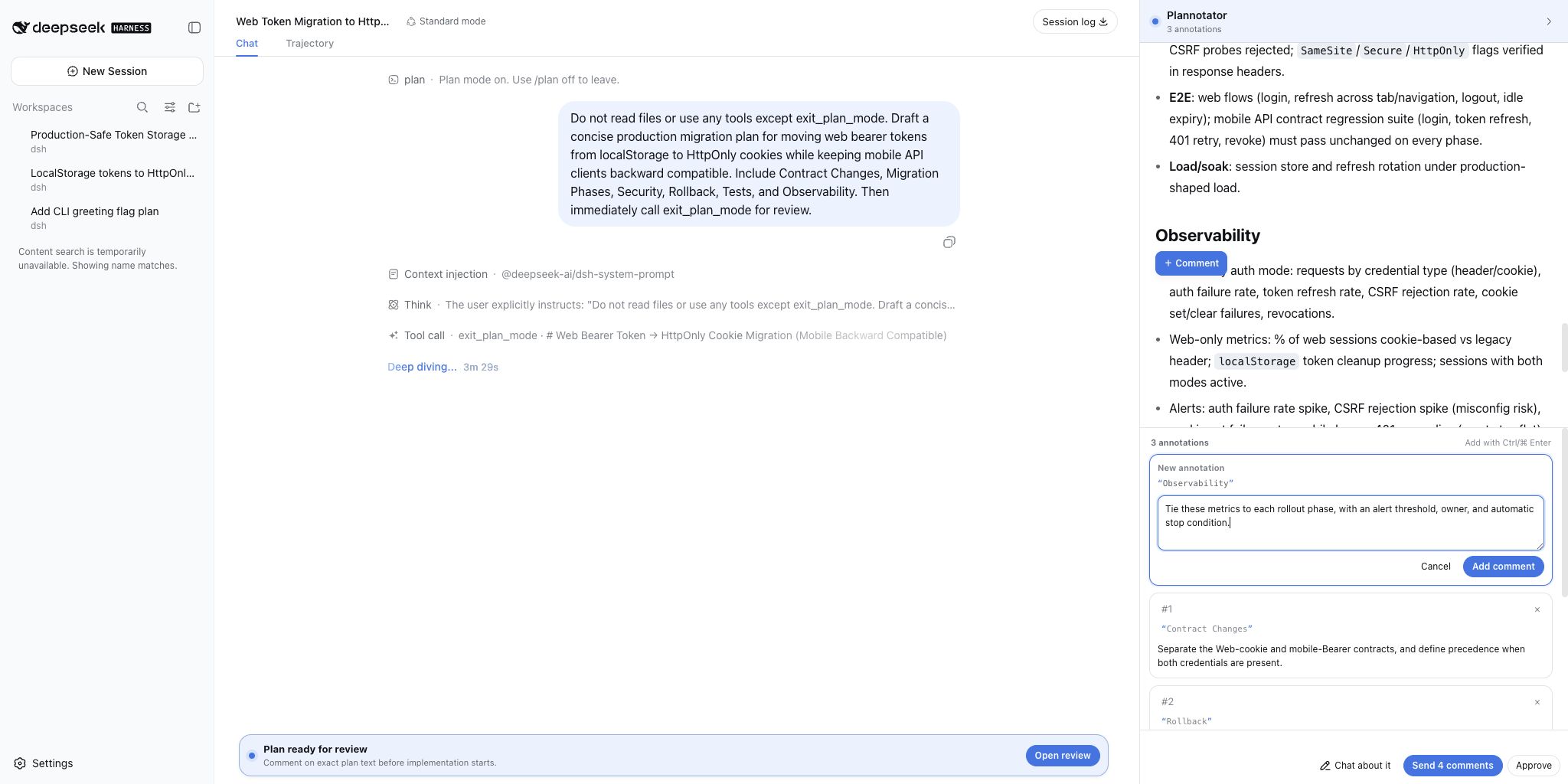
Review the whole plan in one pass
Collect multiple comments across compatibility, security, rollback, and tests;
add overall feedback; click an annotation in the review panel to return to its
source; then send one coherent review. This keeps the review compact and less
ambiguous than a sequence of detached chat messages.
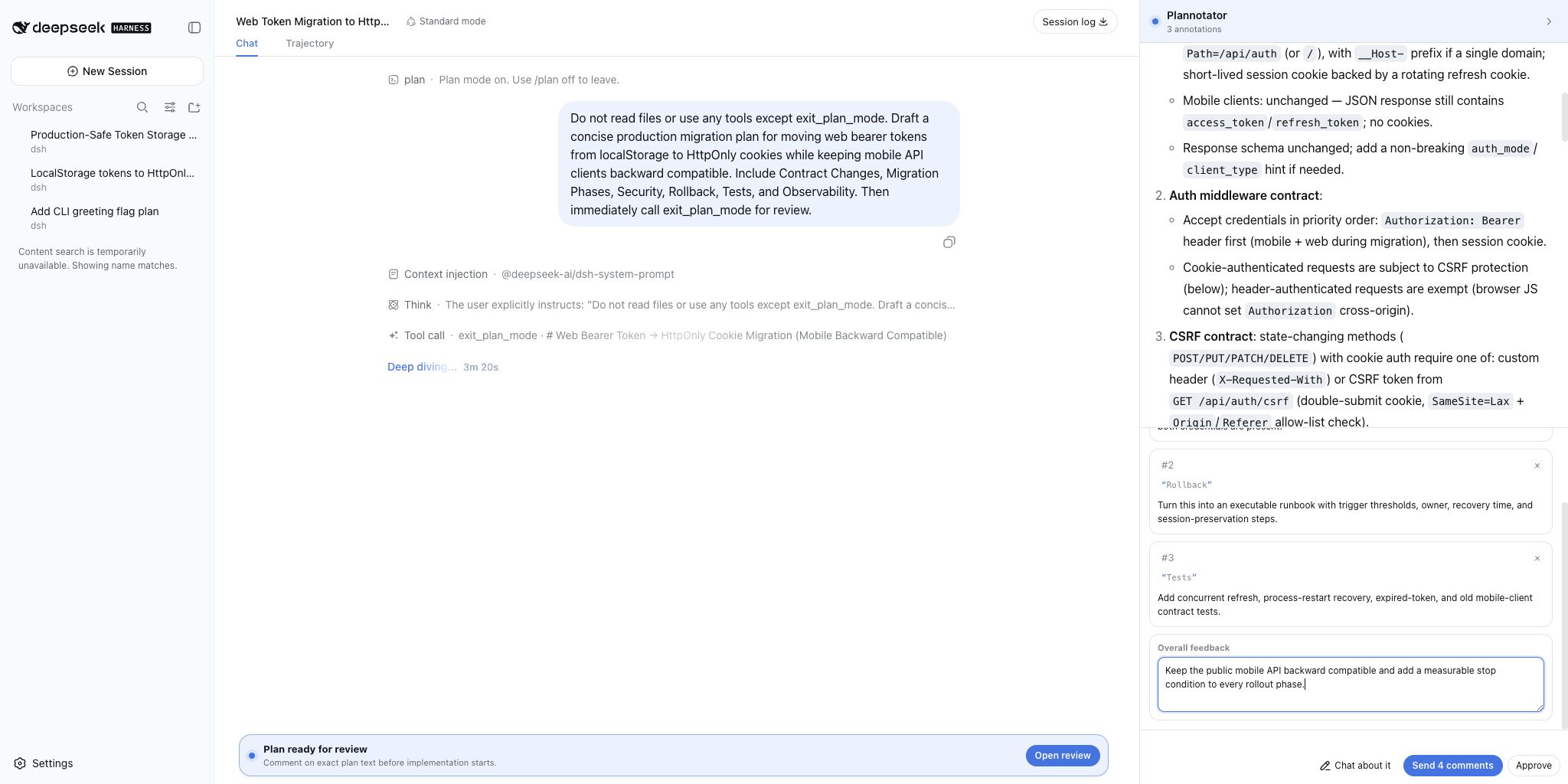
Collapse the review without losing your place
The review panel can shrink to a blue edge rail while the compact composer gate
remains visible. Reopen either control to continue with the same comments and
overall feedback.
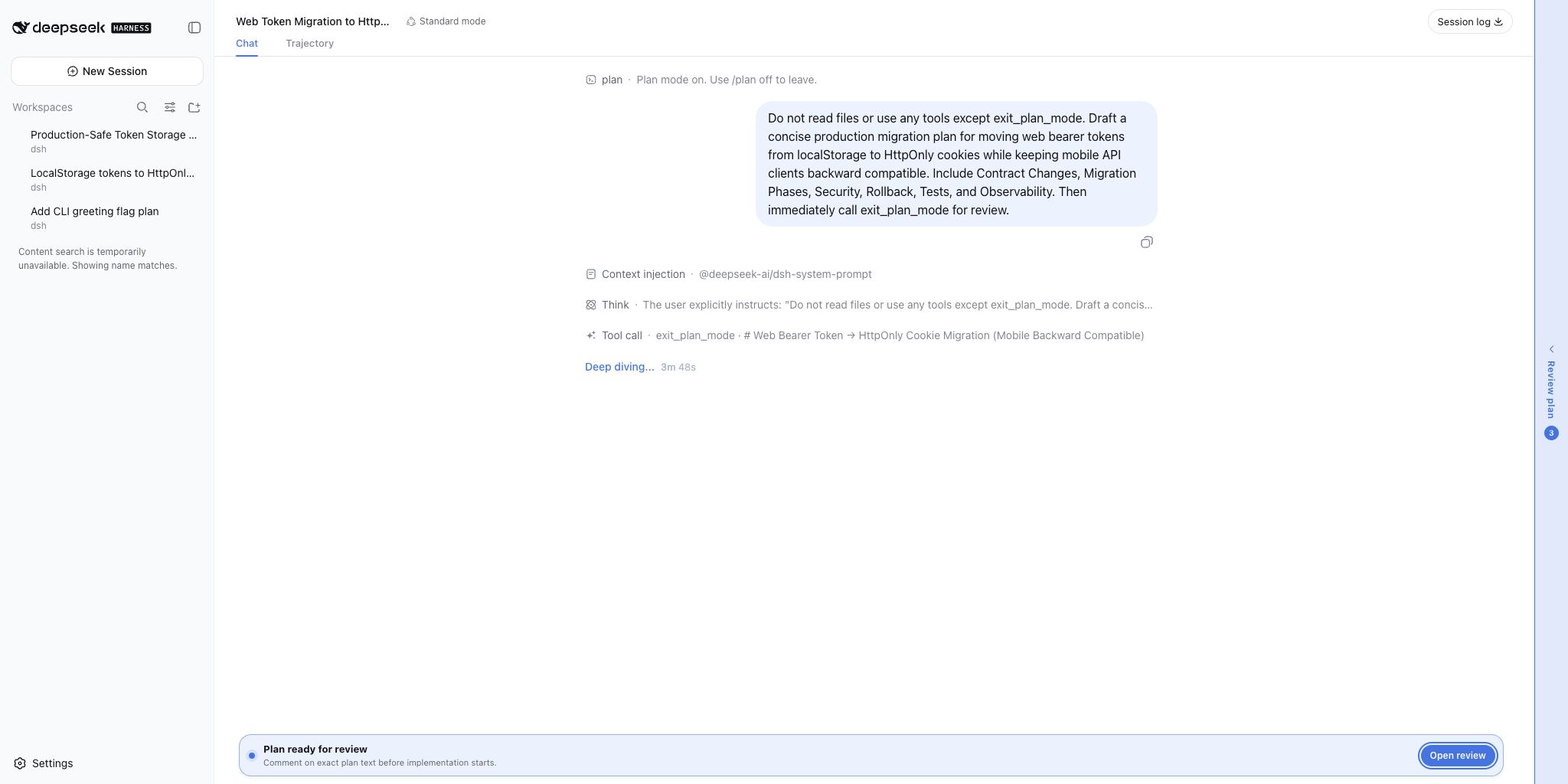
Return actionable feedback to the agent
Send feedback answers the real exit_plan_mode interaction. DSH records the
quoted plan text, each requested change, and the overall feedback in the tool
result and Session Log. The agent remains in plan mode and can immediately
produce a revised proposal.
Ask AI about the plan
Select plan text and choose ✦ Ask AI to stage the excerpt, or just type
into the Ask AI sidebar that sits permanently to the left of the plan
preview. The question travels with the plan text, the quoted
excerpt, and your earlier Q&A to a one-shot subagent of the reviewed session —
a fork that inherits the same model, workspace, and earlier conversation
turns (the plan itself always rides along verbatim, since it was submitted in
the still-open review turn) — that can inspect the repository with read-only
tools (read, grep, glob, web_search, web_fetch, probed against the
session's actual tool set). The answer renders inline as Markdown; follow-up
questions keep the thread's context, and Stop cancels a slow answer. The
thread survives navigating into the answering subagent and page reloads (it is
kept locally like annotation drafts), so an in-flight answer still lands when
you come back. Stop silently drops the pending question, while a host-side
cancellation stays visible as an error entry with Retry. The answering child
never modifies files, never rewrites the plan, and cannot delegate further.
Protect unfinished reviews
Unsent comments are saved locally in the browser, isolated by Session, pending
request, and plan revision. If you try to approve while feedback is still
pending, the plugin requires an explicit second confirmation instead of
silently discarding your work.
| Capability | What you get |
|---|---|
| Precise annotations | Text selection plus a reliable double-click block fallback |
| Multi-comment review | Anchored comments, source navigation, deletion, and overall feedback |
| Responsive review column | Side-by-side on wide screens, an on-demand drawer on narrower desktops, and a bottom sheet on phones |
| DSH response loop | Approve, request changes, or return to chat through the existing pending interaction |
| Ask AI | Plan Q&A by a one-shot read-only subagent, with quoted excerpts, follow-ups, and cancellation |
| Draft recovery | Best-effort local recovery without a plugin server or third-party service |
| Review safeguards | Stale-plan draft rejection and explicit confirmation before discarding feedback |
| UI fit | English and Chinese copy, keyboard shortcuts, responsive layout, and DSH theme tokens |
📦 Install
Install the GitHub bundle into the DSH Web profile, then restart dsh web:
dsh plugin --profile web add github:titanwings/dsh-plannotator#v0.1.4
The repository ships its built Host and Web bundles, so installation runs no
package build script and needs no allowBuilds entry. Pin a reviewed commit SHA
instead of the release tag when you need an exact source revision.
Install from a local checkout
Use Node.js 22.19+:
pnpm install
pnpm check

cd /path/to/deepseek-harness
pnpm dsh plugin --profile web add /path/to/dsh-plannotator
Restart dsh web after changing the installed Client plugin set.
🔄 How it works
- Ask the coding agent to create a plan in DSH Plan mode.
- When
exit_plan_modereaches Plan Review, DSH shows a compact gate. On wide
screens the review opens beside the conversation; narrower screens keep it
closed until you choose Open review. - Select the exact text that needs work. Collapse and reopen the panel at any
time without settling the review. - Add as many targeted comments as necessary, plus optional overall feedback.
- Choose Send feedback. The agent receives one structured review and stays
in plan mode. - Review the revision and choose Approve when it is ready to implement.
Chat about it dismisses the gate and returns to the ordinary composer.
Removing the plugin restores DSH's built-in Plan Review automatically.
Built for real coding plans
The screenshots above use a production-style authentication migration example,
not placeholder copy. The same workflow is useful whenever several plan details
must be correct before the first edit:
| Plan | Useful review comments |
|---|---|
| Database or auth migration | Compatibility window, idempotent migration, rollback threshold, zero-downtime sequencing |
| Public API refactor | Contract preservation, deprecation path, versioning, mobile or SDK compatibility |
| Security change | Trust boundaries, CSRF and secret handling, audit evidence, failure behavior |
| Deployment rollout | Feature-flag phases, observable stop conditions, owners, rollback rehearsal |
| Test strategy | Missing failure cases, concurrency, restart recovery, regression and acceptance criteria |
🧩 Compatibility and boundaries
- Designed for the DeepSeek Harness Web client and Node.js 22.19+.
- Claims only a valid, single-question DSH
plan-reviewinteraction. Other
questions fall through to the built-in renderer. - Reviews Markdown plans; it is not a general document editor, Git diff viewer,
PR publisher, file tree, or the full standalone Plannotator SPA. - Drafts live in the current browser's local storage. They are not cloud-synced
and are intentionally rejected when the plan revision changes. - At 1480px and above, the plugin reserves a 440–560px companion column beside
DSH, so the panel and conversation never overlap. Narrower desktops use an
on-demand drawer; phones use a compact bottom sheet. - The companion panel is plugin-owned, not DSH's core
detailspanel. It uses
the stable Web#rootmount boundary to reserve space and lets AppFrame
reflow normally; it does not register in or rewrite the core details grid. - The Ask AI channel is a loopback/trusted-host RPC channel (
/dsh-plannotator)
on DSH's shared Connection transport. Each question runs as a one-shot
subagent (labelledplan-ask, visible in the session's subagent list) that
forks the reviewed session — inheriting its model, composition, and completed
conversation turns — under a read-only tool filter (a composition without the
fork provider, or whose fork lacks the requested tool-filter/persona
capabilities, falls back to a fresh child). Answers are unary (no streaming
yet), capped at 32k characters so they always fit a follow-up's context, and
the Q&A thread is kept in local storage per review — it survives panel
navigation and reloads, unlike annotation drafts which reject stale plans. - Feedback travels through DSH's existing response channel. No third-party
service or telemetry is used.
How it fits DSH's Cordis architecture
The bundle inserts one Cordis Loader row. Its Host entry registers only the
Ask AI RPC channel on the shared Connection transport; package.json#dsh.client
exposes the Web bundle. The Client registers its locale namespace and aconversation.composer chain entry at priority -10, ahead of the default
question renderer, and selects only Plan Review requests. That contribution
renders the compact gate and mounts the plugin-owned panel through a React
portal. Wide layouts reserve matching space at the stable Web root; narrower
layouts reuse the panel as an on-demand drawer or bottom sheet.
There is no DSH core patch, parallel agent loop, duplicate persistence layer,
or custom scheduler. Unloading the Cordis row removes the slot contribution and
reveals the built-in UI again.
🛠️ Development
pnpm typecheck
pnpm test
pnpm build
The browser bundle follows DSH's window.__ModuleLoader__ contract and treats
React, ReactDOM, and DSH UI primitives as platform modules, preserving one React
runtime.
安装
装一次目录插件,之后本站所有插件都能让 DeepSeek Harness 自动找、自动装:
dsh plugin add dshbase-catalog然后对 agent 说「帮我装 dsh-plannotator」,它会在目录里找到并自动安装。文档:dshbase-catalog · 已验证场景包。
该插件是 GitHub 源码(未发 npm)——直接从仓库装:
Web profile:
dsh plugin --profile web add github:titanwings/dsh-plannotatorHeadless(CLI)profile:
dsh plugin --profile headless add github:titanwings/dsh-plannotatordsh plugin --profile web add https://dshbase.com/builds/dsh-external-dsh-plannotator-0.1.3.tgz实测报告
验证通过:从 GitHub 源码完成 L1 安装 + L2 加载 + L3 运行(dsh 0.1.0-rc.6)。
使用场景
自动化一项重复工作——调度、串联任务或响应事件——不用你亲手启动。
适合谁
有周期性工作、想 cron 式无人值守而非手动触发的人。
二次开发建议
触发器和任务模板是缝——加事件驱动或文件监听触发,以及更丰富的流程编排。
分享徽章
把这枚徽章粘进 README——它会链回本页,实测状态变化时自动更新:

[](https://dshbase.com/zh/plugins/dsh-plannotator/)<a href="https://dshbase.com/zh/plugins/dsh-plannotator/"><img src="https://dshbase.com/badges/dsh-plannotator.svg" alt="dshbase 实测可装"></a>