
插件目录 / Automation / dsh-plugin-greet
dsh-plugin-greet
已验证 · 实测可装 0lidaxiang
功能简介
DSH插件系统,工具/模型/UI均可增改
可用 — 实测通过,早期项目
DSH插件系统,工具/模型/UI均可增改 实测能干净安装、正常启动。早期项目,但功能可用。
「已验证」表示我们的自动化 CI 在干净 profile 里实际执行了 dsh plugin add 并启动成功——仅此而已。功能描述与版本兼容性均为作者声明。这不是安全审计,也不代表对第三方代码的背书。
README
dsh-plugin-greet
English | 简体中文
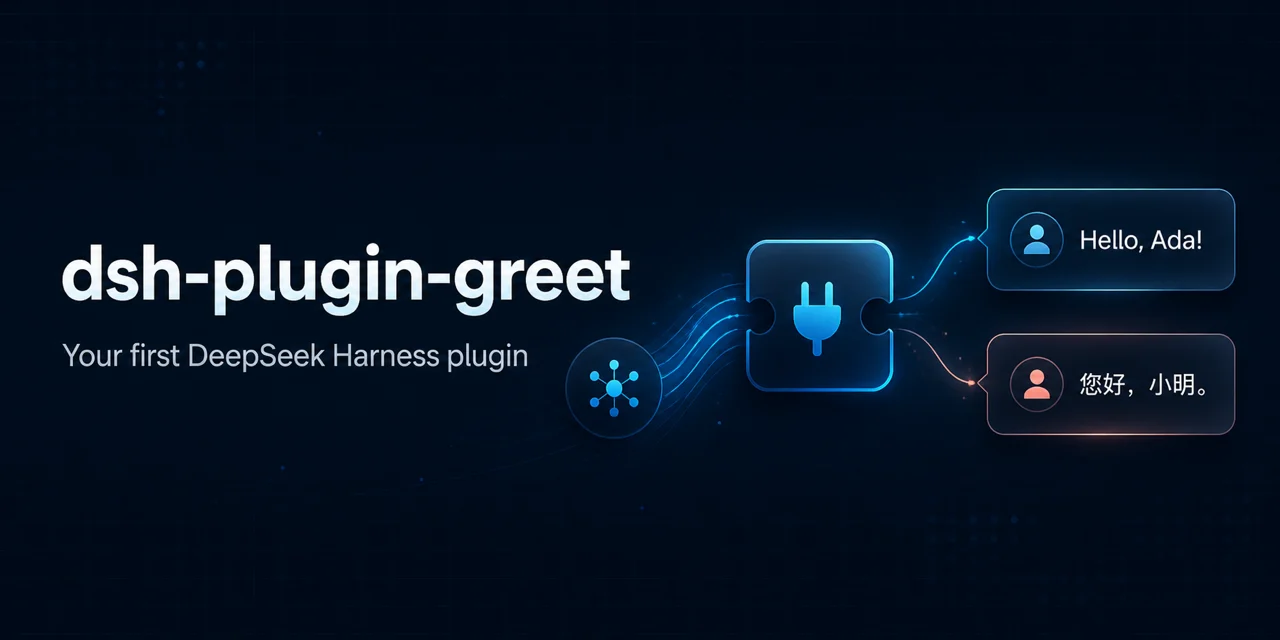
A beginner-friendly, installable DeepSeek Harness plugin that demonstrates bundle distribution, profile composition, plugin configuration, tool schemas, structured output, validation, testing, and a real model-driven tool call.
This is a community example, not an official DeepSeek AI plugin. DeepSeek Harness is currently in Developer Preview, so future releases may require compatibility updates.
What you will learn
This repository keeps the implementation in one small entry file so that a new plugin author can follow the complete path:
User prompt
  → model chooses the greet tool
  → argument schema checks the shape
  → execute validates and normalizes values
  → the tool returns structured data
  → output.render creates model-facing text
  → the model writes its final response
The example covers:
- exporting a validated plugin
Config - injecting and using the Harness
toolsservice - required and optional tool arguments
- English and Chinese greetings
- friendly and formal styles
- structured canonical output with a text renderer
- actionable validation errors
- unit tests and CI packaging checks
Tool contract
The plugin registers one model-callable tool named greet.
Input
| Field | Required | Values | Default |
|---|---|---|---|
name |
Yes | Non-empty string, at most 80 characters | — |
language |
No | en, zh |
Plugin configuration |
style |
No | friendly, formal |
Plugin configuration |
Leading and trailing whitespace is removed from name. Unknown arguments, empty names, unsupported languages, and unsupported styles are rejected with clear errors.
Output
The canonical result is structured data:
{
  "message": "Hello, Ada!",
  "name": "Ada",
  "language": "en",
  "style": "friendly"
}
output.render converts that value into the model-facing text:
Hello, Ada!
This separation lets other plugins or policies use the structured fields without making the model read raw JSON.
Greeting examples
| Language | Style | Result |
|---|---|---|
| English | Friendly | Hello, Ada! |
| English | Formal | Greetings, Ada. |
| Chinese | Friendly | 你好,小明! |
| Chinese | Formal | 您好,小明。 |
Install from npm
Stop any running DeepSeek Harness instance, then install the package into the web profile:
npx @deepseek-ai/dsh plugin --profile web add [email protected]
This command does more than a regular npm install: it installs the package into the selected Harness profile and adds its declared bundle to the profile composition.
Before starting, confirm that the bundle is present in the final configuration:
npx @deepseek-ai/dsh --profile web --dump-config
Then start the Web UI:
npx @deepseek-ai/dsh web
Try the tool
Open http://127.0.0.1:3080 and send:
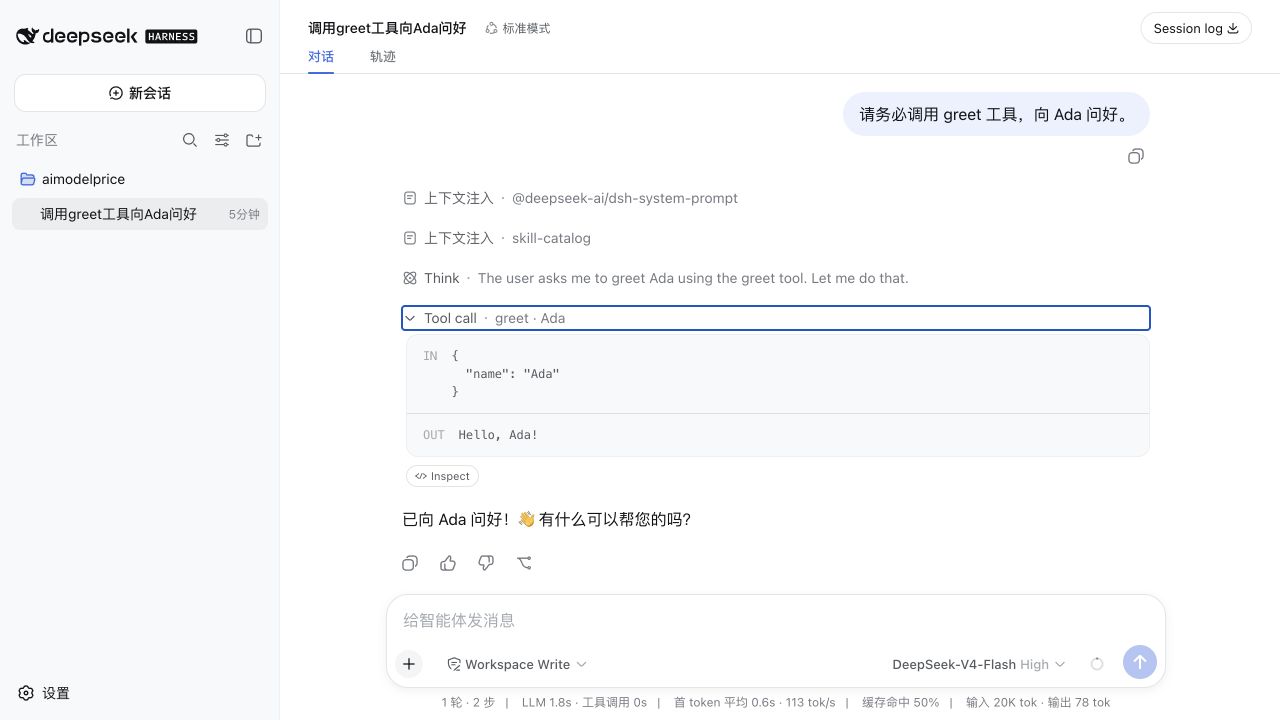
You must use the greet tool to greet Ada in a friendly English style.
The expected tool call is:
IN  { "name": "Ada", "language": "en", "style": "friendly" }
OUT Hello, Ada!
Try Chinese formal output:
You must use the greet tool to greet 小明 in formal Chinese.
Expected result:
IN  { "name": "小明", "language": "zh", "style": "formal" }
OUT 您好,小明。
The plugin does not listen for keywords such as Hello. It makes the tool available to the model, and the model decides whether to call it. Explicitly naming the greet tool makes the behavior easier to verify.
Configure the plugin
The exported configuration schema supplies these defaults:
greeting: Hello
punctuation: "!"
defaultLanguage: en
defaultStyle: friendly
To override them, restate the plugin row in a later patch layer, such as the profile's cordis.patch.yml:
- insert:
    - id: greet-tool
      name: dsh-plugin-greet
      config:
        greeting: Hi
        punctuation: "!"
        defaultLanguage: en
        defaultStyle: friendly
With that configuration, a call containing only { "name": "Grace" } returns Hi, Grace!.
greeting and punctuation customize friendly English output. Chinese and formal wording use the built-in examples shown above. defaultLanguage and defaultStyle are used only when the model omits those arguments.
Later patch layers replace the entire row configuration rather than deep-merging individual keys, so keep id, name, and the complete desired config together.
Install from GitHub
To install the current development branch:
npx @deepseek-ai/dsh plugin --profile web add \
  github:0lidaxiang/dsh-plugin-greet#master
For stable usage, prefer a published npm version, release tag, or specific commit SHA.
Install from a local checkout
Run this command from the parent directory of the repository:
npx @deepseek-ai/dsh plugin --profile web add ./dsh-plugin-greet
After changing the code, restart DeepSeek Harness and verify the tool through the chat interface.
Develop and test
Install dependencies and run the unit tests:
npm install
npm test
Run the complete local check, including the npm package preview:
npm run check
The test suite verifies configuration defaults, registration metadata, all four greeting modes, structured output rendering, whitespace normalization, invalid values, unknown arguments, and length limits. GitHub Actions runs the same checks on Node.js 20 and 22.
Troubleshooting
The model replies but does not call greet
Say explicitly: You must use the greet tool.... A normal greeting such as Hello does not force a tool call.
The tool is not listed
Stop the running Harness process, reinstall the plugin into the same profile, inspect --dump-config, and then restart the Web UI.
npm install dsh-plugin-greet worked, but the tool is missing
A regular npm install only adds a dependency to the current Node.js project. Use dsh plugin --profile <name> add ... to install and compose the bundle into a Harness profile.
My configuration did not take effect
Make sure your later patch restates the row with the same id (greet-tool), the package name, and the complete config object.
Project structure
dsh-plugin-greet/
├── .github/
│   ├── assets/social-preview.png # GitHub social preview image
│   └── workflows/ci.yml          # Tests and package checks
├── docs/
│   ├── README.zh-CN.md       # Chinese documentation
│   ├── greet-tool-result.png # README screenshot
│   └── readme-hero.webp      # Lightweight README hero
├── tests/greet.test.js       # Node.js unit tests
├── cordis.patch.yml          # Inserts the plugin into a profile
├── index.js                  # Config and greet tool implementation
├── package-lock.json         # Reproducible dependency versions
├── package.json              # Package and dsh.bundle metadata
└── LICENSE
Security and compatibility
DeepSeek Harness plugins run inside the host process. Review third-party plugin source code before installation, and prefer a pinned release tag or commit SHA.
The plugin has no network, filesystem, shell, or credential access. It depends only on the official @deepseek-ai/schemastery package for configuration validation.
The original 0.1.x release line was verified with @deepseek-ai/dsh 0.1.0-rc.6. Run the included tests and a real profile installation when upgrading Harness versions.
License
安装
装一次目录插件,之后本站所有插件都能让 DeepSeek Harness 自动找、自动装:
dsh plugin add dshbase-catalog然后对 agent 说「帮我装 dsh-plugin-greet」,它会在目录里找到并自动安装。文档:dshbase-catalog · 已验证场景包。
Web profile:
dsh plugin --profile web add dsh-plugin-greetHeadless(CLI)profile:
dsh plugin --profile headless add dsh-plugin-greet包信息
npm:dsh-plugin-greet · 版本 — · 实测环境 dsh 0.1.0-rc.6
实测报告
端到端验证通过:dsh 0.1.0-rc.6 上 L1 安装 + L2 加载 + L3 运行问答。
使用场景
自动化一项重复工作——调度、串联任务或响应事件——不用你亲手启动。
适合谁
有周期性工作、想 cron 式无人值守而非手动触发的人。
二次开发建议
触发器和任务模板是缝——加事件驱动或文件监听触发,以及更丰富的流程编排。
分享徽章
把这枚徽章粘进 README——它会链回本页,实测状态变化时自动更新:

[](https://dshbase.com/zh/plugins/dsh-plugin-greet/)<a href="https://dshbase.com/zh/plugins/dsh-plugin-greet/"><img src="https://dshbase.com/badges/dsh-plugin-greet.svg" alt="dshbase 实测可装"></a>