
插件目录 / Developer / dsh-smart-restart
dsh-smart-restart
已验证 · 实测可装 edusrez
功能简介
Wakes the main agent after any DSH restart so interrupted work resumes automatically — adds a restart tool and an optional canary that validates the boot and warns instead of breaking.
可用 — 实测通过,早期项目
Wakes the main agent after any DSH restart so interrupted work resumes automatically — adds a restart tool and an optional canary that validates the boot and warns instead of breaking. 实测能干净安装、正常启动。早期项目,但功能可用。
「已验证」表示我们的自动化 CI 在干净 profile 里实际执行了 dsh plugin add 并启动成功——仅此而已。功能描述与版本兼容性均为作者声明。这不是安全审计,也不代表对第三方代码的背书。
README
dsh-smart-restart
English | 中文
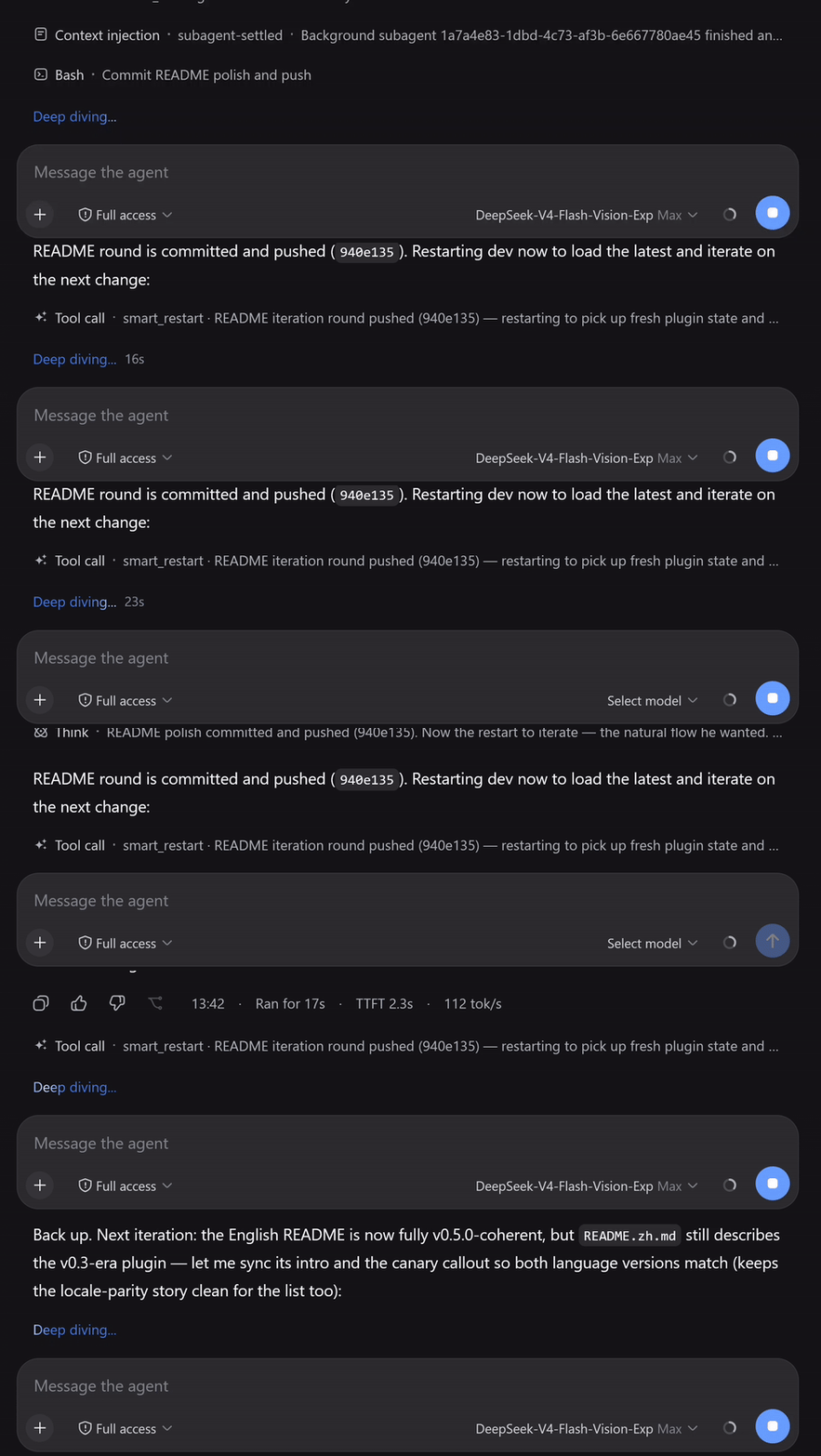
A real-time restart: the agent restarts the service (canary pre-flight passing, Canary: passed — restarting…), and the plugin's boot notification brings the very same session right back — the conversation continues automatically, no user prompt needed.
A DeepSeek Harness (DSH) host plugin that keeps the main agent aware of service restarts — without the user having to prompt it. On every boot it detects that a new process has taken over, wakes the target agent with a short "Smart-restart" notice (boot time, previous boot, downtime). New in v0.2.0 it added the smart_restart tool to restart DSH itself and return the notice to the exact session that asked; new in v0.3.0 it auto-detects when the service was stopped while an agent session was active, so even a plain systemctl restart the agent ran notifies that session at boot; new in v0.4.0 it can validate the launch first with an optional canary pre-restart gate that aborts the restart when an ephemeral boot fails. New in v0.5.0 it auto-detects the systemd unit from /proc/self/cgroup, so the tool and the canary work with zero config on systemd-managed installs.



Table of contents
- Overview
- How it works
- The
smart_restarttool - Canary pre-restart validation
- Requirements
- Install
- Configuration
- Behavior & lifecycle
- Limitations
- Development
- License
Overview
A long-lived DSH instance restarts for many reasons: the agent installs or reconfigures a plugin and triggers a reboot, the host machine reboots, or the service is restarted under systemd. After any such restart the agent is up and running again, but it has no idea that anything happened — the previous session is gone. Today, the only way to get the agent to pick back up is for the user to tell it, usually with something like "you restarted".
dsh-smart-restart closes that gap. It detects the restart itself and wakes the main agent at boot with a short, self-contained notice describing what happened, so the agent decides whether to resume interrupted work, note the downtime, or simply acknowledge — no user prompt needed.
New in v0.3.0, the plugin also covers the unplanned restart of an active agent. It tracks the last active session and, on shutdown (SIGTERM/SIGINT), persists a shutdown-notice.json; on boot it pins the notice back to that session (when it was active within shutdownGraceMs). So a plain systemctl restart the agent ran — or a restart that happened while an agent was mid-task — is auto-notified without the user prompting. v0.2.0 let the main agent cause restarts: the smart_restart tool records the calling session and restarts DSH through systemd, returning the notice to that exact session.
- Zero prompting — the user never has to tell the agent "you restarted".
- Self-restart — the main agent can restart DSH itself and resume its task automatically afterwards.
- Automatic wake — an idle main agent is woken and handed the notice on its own.
- Targeted delivery — the post-restart notice returns to the session that requested it; otherwise the
targetconfig decides where it lands. - Precise context — the notice carries the boot time, the previous boot time, the downtime, and an optional reason.
- Canary safety — an optional pre-restart gate boots an ephemeral DSH instance and aborts the restart when it fails (see below).
- Self-contained — a single host bundle; nothing to run, no external service.
How it works
On every boot the plugin:
- Reads the previous marker — a durable
marker.json({lastBootAt, pid, dshVersion?}) stored under<DSH_HOME>/<stateDir>/. - Detects a restart — a previous marker with a different
pidthan the currentprocess.pidmeans a new process has started, i.e. the service restarted; downtime isnow − previous lastBootAt, clamped to≥ 0. - Writes a new marker immediately, so the next boot can be compared against this one.
- Checks for a pending notice — if the
smart_restarttool left apending-notice.jsonbefore the previous restart, this boot pins delivery to that exact session (highest priority; the file is consumed once read). - Checks for a shutdown notice — if there was no pending notice, the plugin reads
shutdown-notice.json(written by the previous process onSIGTERM/SIGINT, recording the last active session). If that session was active withinshutdownGraceMs, this boot pins delivery to it (second priority); otherwise the pin is skipped and delivery falls back totarget. The file is consumed once read. - Delivers the notice — once per boot via the source-agnostic
agent/session-starthook (a pinned session is matched regardless of publication source, so a session that resumes withsource: 'resume'is caught too), backed by a bounded poll (750ms tick, ~15s cap) that picks up a pinned session which resumes lazily late.
There are three delivery paths, depending on how the restart happened:
(a) Agent-initiated restart (smart_restart tool)
The main agent calls smart_restart(reason?). The tool:
- validates the configured
restartUnittoken, - persists the pending notice synchronously (calling session + optional reason) to
pending-notice.jsonunder the state dir, before any spawn so it survives the imminent service kill, - spawns a detached
setsid bashprocess (a ~1s delay lets the tool's response be written) that runssystemctl restart <unit>and survives this process being killed by systemd, - returns
{ok: true, restarting: true, ...}.
On the next boot, step 4 above reads the pending notice, pins it to the calling session (highest priority), and the notice returns there — regardless of source — so the agent that asked resumes its interrupted task.
(b) Smart shutdown auto-detection (plain restart while an agent was active)
If there is no pending notice, the plugin looks for a shutdown-notice.json. This file is written synchronously by the previous process on SIGTERM/SIGINT, recording the last active session (tracked on agent/session-start and agent/pre-step) and its timestamp. On boot the plugin pins the notice to that session only if it was active within shutdownGraceMs of shutdown (recent activity ⇒ the user restarted while the agent was mid-task, so auto-notify). If the session was idle well before shutdown (the user probably restarted while idle), the pin is skipped and delivery falls back to target.
This is what makes a plain systemctl restart that the agent ran — or a restart that happened while an agent was active — auto-notify that session at boot, with no user prompt and no need to have called smart_restart.
(c) External restart (systemd, host reboot, dev tools) — no active session
There is no pending notice and no usable shutdown notice (either none was written, or the last activity predates shutdownGraceMs). The boot falls back to the target config (primary | all | <session-id>) to decide which agent(s) get the notice. The source === 'startup' gate applies only to this non-pinned path.
Restart vs. HMR semantics
The detection is intentionally precise:
| Situation | Detected as a restart? |
|---|---|
| New OS process, previous marker exists | Yes — service (re)started. |
| Same OS process (in-process HMR / hot-reload) | No — ignored. |
| First-ever boot (no marker) | No — nothing to compare against. |
Marker present but stale/corrupt lastBootAt |
Yes — downtime reported as 0. |
Only a genuinely new process counts as a restart. An in-process hot-reload keeps the same pid, so it is not treated as a service restart. Delivery happens once per boot: a deliveredIds set plus a primary guard (for the primary target) prevent the startup event and the fallback poll from double-sending.
Notice
The default notice (English) reads:
Smart-restart: the DSH service restarted at
<iso>. Previous boot:<iso>(downtime ~2m 9s). If a task was in progress, resume it; otherwise reply with a one-line acknowledgment.
When a reason was recorded by smart_restart, it is appended (… reason: <reason>.) before the resume instruction. The previous-boot/downtime segment is omitted when no previous boot time is known, and the whole text is fully customizable via the notice config (see below).
The smart_restart tool
Registered via ctx.tools.register in apply (so it is available to agent sessions) when toolEnabled is true (the default). It lets the main agent restart DSH itself through systemd.
Parameters
| Param | Type | Required | Description |
|---|---|---|---|
reason |
string | no | Optional human-readable note, e.g. "installed dshmarket in stable+dev". Included in the post-restart notice. |
canary |
boolean | no | Optional canary pre-restart validation for THIS call: boots an ephemeral DSH instance and aborts the restart on failure (see Canary pre-restart validation). Overrides the configured canary for this call. |
Behavior
- Validates the configured
restartUnit— a single systemd unit token (/^[A-Za-z0-9_.@-]+$/, no spaces/slashes) to prevent shell injection into the detached command. - Fails fast when
restartUnitis not configured and auto-detection from/proc/self/cgroupfinds no unit either (ok: false, errorrestartUnit not configured) rather than guessing a unit — an emptyrestartUnitis auto-detected first, and only a failed detection produces that error. - Persists
pending-notice.jsonsynchronously (before any spawn) so it survives the service kill and targets the restarting session. - Restarts via a detached
setsid bashprocess (sleep 1 && systemctl restart <unit>) that outlives this process, then unrefs it. - Returns
{ok: true, restarting: true, sessionId, reason}on success, or{ok: false, restarting: false, error}when it fails.
Intended agent flow
install/change a plugin
  → call smart_restart(reason)   # e.g. "installed dshmarket in stable+dev"
  → DSH restarts (detached, ~1s)
  → after boot, the notice returns to THIS session (pinned)
  → the task continues automatically — no user prompt needed
Safety notes
- The unit token is validated against a strict regex to block shell injection through
restartUnitinto the detached shell command. - The tool targets a systemd-managed DSH install (
setsid/systemctl); it does not apply to a bare process without a systemd unit.
Canary pre-restart validation
New in v0.4.0. Optional, opt-in, and fully generic — it works on any DSH
install:restartUnitis the only tool config you may need to set (auto-detected since v0.5.0 when empty on systemd installs).
When enabled, the smart_restart tool can validate the launch before anything is persisted or restarted: it boots an ephemeral DSH instance from the same binary and profile as the systemd unit, verifies it starts, and only then proceeds with the real systemctl restart. A failed canary aborts the restart — no pending notice is written, nothing is spawned, and the calling session is alerted live (same plugin-source notice channel).
What it does, step by step
- Resolves the dsh binary/profile — an explicit
canaryBinary/canaryProfilewins; otherwise both are derived fromsystemctl show -p ExecStart <restartUnit>(binary falls back todshon PATH). The--profileflag is omitted when no profile resolves. - Creates a temp state dir and a temp patch overlay (
dsh --patch <tmp>/canary.patch.yml, applied after the profile layer): thesmart-restartrow itself is disabled in the canary (enabled: false) and everycanaryStateDirOverridesentry gets itsstateDirredirected into the temp dir — so the canary never writes a marker, notice, or live board state. - Pre-flights the launch with
--dump-config(20s timeout; a compose failure aborts the restart). - Boots the ephemeral instance detached with the same overlay on an auto-picked free port (
canaryPortwhen set) and pollshttp://127.0.0.1:<port>/until HTTP 200 orcanaryTimeoutMselapses (per-attempt 800ms; a refused connection or non-200 is "not yet"). - Stops the ephemeral (process-group kill) and returns:
passed→ the restart proceeds;failed→ abort + alert the caller;skipped→ the restart proceeds (a skip is not a failure).
When it skips (never blocks) — if the dsh binary/profile cannot be derived (no systemctl lookup result AND no explicit canaryBinary/canaryProfile), the canary reports skipped and the restart proceeds unchanged. Generic installs are therefore always safe: a canary failure only ever aborts a restart when you opted in with an actual, resolvable launch target.
How to enable
- Per profile: add
canary: true(plus any overrides) to thesmart-restartrow. The per-profile patch row REPLACES the row's whole config, so restate your existing fields (see the example in Configuration). - Per call (agent-facing): call
smart_restart(canary: true, reason), which overrides the configured default for that single call.
Config fields
| Key | Type | Default | Description |
|---|---|---|---|
canary |
boolean | false |
Master opt-in for the canary gate. |
canaryTimeoutMs |
number | 45000 |
Hard window (ms) for the canary boot liveness probe; a timeout is a canary failure and aborts the restart. |
canaryPort |
number | 0 |
HTTP port for the ephemeral canary instance; 0 auto-picks a free port. |
canaryProfile |
string | '' |
Explicit dsh profile for the canary launch; empty derives from the unit's ExecStart (--profile). |
canaryBinary |
string | '' |
Explicit dsh binary for the canary launch; empty derives from the unit's ExecStart, else dsh on PATH. |
canaryStateDirOverrides |
object | {} |
Plugin-row id → temp dir: those rows get their stateDir redirected in the canary patch (e.g. deepartments: '' keeps the canary off live board state). Relative or empty values resolve under the canary temp dir; absolute values are used verbatim. |
Note on overrides and row replacement. Patch rows replace their row's
WHOLE config (no merge) — and the canary is a throwaway instance, so a
listed row gets only itsstateDiroverridden and its remaining config
reverts to that plugin's own defaults. UsecanaryStateDirOverridesonly
for rows that boot fine with defaulted config (the live profile's row is
untouched). Rows that don't exist in the canary's composed tree are skipped
with a loader warning.
Output — when a canary ran, the tool result carries canary (passed /skipped / failed) plus canaryDetail, and the rendered response gains aCanary: … line (Canary: passed — restarting…, Canary: failed — restart ABORTED: <detail>, or Canary: skipped — <detail>).
Requirements
- DSH
0.1.0-rc.7+/0.1.1-rc.x— a long-lived instance with a live main-agent session (the web / GUI profile). This plugin is designed for a continuously-running service whose main agent stays resident; it is not aimed at the one-shot headless CLI. - systemd-managed DSH install for the
smart_restarttool — v0.5.0 auto-detects the service unit from/proc/self/cgroup; setrestartUnitexplicitly when the unit differs or on non-systemd (where the tool fails safe). - Node.js / pnpm — the usual DSH toolchain for building and installing host bundles.
Install
dsh-smart-restart is a DSH host bundle: package.json carries dsh.bundle.patch = ./cordis.patch.yml, so installing the package lets the plugin layer auto-join the profile's dsh.profile.bundles.
# From a registry (npm)
dsh plugin --profile <name> add dsh-smart-restart

# Or link a local checkout while developing
dsh plugin --profile <name> add /path/to/dsh-smart-restart
A restart is required after add — which is exactly the scenario this plugin exists to surface. The bundled patch inserts the layer into the profile's layer stack:
# cordis.patch.yml (bundled with this package)
- insert:
    - id: smart-restart
      name: dsh-smart-restart
      config:
        enabled: true
        stateDir: .smart-restart
        target: primary
        wakeup: true
        notice: ''
        restartUnit: ''   # OPTIONAL since v0.5.0 — auto-detected on systemd installs; set explicitly when the unit differs
        toolEnabled: true
restartUnitis OPTIONAL since v0.5.0 on systemd installs. The plugin
auto-detects its own systemd unit from/proc/self/cgroup, so thesmart_restarttool (and the canary'sExecStartderivation) work with
zero config on a systemd-managed DSH install. SetrestartUnit
explicitly when the unit name differs from the auto-detected one or when
detection is unavailable (e.g. a bare non-systemd process). If you DO set
it, add acordis.patch.ymloverride on thesmart-restartrow —
restating the full config (a partial override would drop the other keys)
— with the unit for that profile. For example, for the stable instance and
the dev instance respectively:
# Override on the smart-restart row — profile "stable" (dsh.service)
- insert:
    - id: smart-restart
      name: dsh-smart-restart
      config:
        enabled: true
        stateDir: .smart-restart
        target: primary
        wakeup: true
        notice: ''
        restartUnit: dsh.service
        toolEnabled: true

# Override on the smart-restart row — profile "deepartments-dev" (dsh-deepartments-dev.service)
- insert:
    - id: smart-restart
      name: dsh-smart-restart
      config:
        enabled: true
        stateDir: .smart-restart
        target: primary
        wakeup: true
        notice: ''
        restartUnit: dsh-deepartments-dev.service
        toolEnabled: true
Because the bundle declares dsh.bundle, the layer auto-joins dsh.profile.bundles on install — no manual profile edit required. restartUnit is usually auto-detected (v0.5.0); add the explicit override above only when the unit name differs or detection is unavailable.
Configuration
All behavior is controlled through the plugin row's config:
| Key | Type | Default | Description |
|---|---|---|---|
enabled |
boolean | true |
Master switch; false skips all processing. |
stateDir |
string | .smart-restart |
Sub-directory under <DSH_HOME> where marker.json, pending-notice.json and shutdown-notice.json are written. |
target |
string | primary |
Which agent(s) to notify when there is no pending/shutdown notice: primary | all | <session-id>. |
wakeup |
boolean | true |
true → agent.followup() wakes the agent and delivers; false → agent.inject() queues model-facing context only (no wake). |
notice |
string | '' |
Optional custom notice text; returned verbatim when non-empty, else the default. |
restartUnit |
string | '' |
Systemd unit to restart when smart_restart is invoked (e.g. dsh.service or dsh-deepartments-dev.service). Since v0.5.0 it is auto-detected from /proc/self/cgroup (the plugin's own unit) when empty; an explicit value always wins. Empty with no detectable unit → the tool fails safe with a clear error. |
toolEnabled |
boolean | true |
Whether the smart_restart tool is registered (available to agent sessions). |
shutdownGraceMs |
number | 600000 |
Grace window (ms, default 10 minutes) before shutdown within which last agent activity counts as "agent-involved" for the smart shutdown auto-notification. If the last-active session was idle beyond this window on shutdown, the pin is skipped and delivery falls back to target. |
ignoredSessionPrefixes |
string[] | ['head-'] |
Session-id prefixes that must never be selected as "last active" for the smart-shutdown auto-notification, so Deepartments department-head sessions (head-<postId>) don't get a spurious post-restart notice. Configurable list; default ON (heads skipped). |
canary |
boolean | false |
Opt-in canary pre-restart validation: boot an ephemeral DSH instance and abort the restart on failure. The per-call canary tool parameter overrides this for one call. |
canaryTimeoutMs |
number | 45000 |
Hard window (ms) for the canary boot liveness probe (default 45s); a timeout is a canary failure and aborts the restart. |
canaryPort |
number | 0 |
HTTP port for the ephemeral canary instance; 0 auto-picks a free port. |
canaryProfile |
string | '' |
Explicit dsh profile for the canary launch; empty derives it from the unit's ExecStart (--profile). |
canaryBinary |
string | '' |
Explicit dsh binary for the canary launch; empty derives it from the unit's ExecStart, else dsh on PATH. |
canaryStateDirOverrides |
object | {} |
Plugin-row id → temp dir; those rows get their stateDir redirected in the canary patch so the ephemeral never writes live state (e.g. deepartments: '' keeps the canary off live board state). Relative or empty values resolve under the canary temp dir; absolute values are used verbatim. |
target semantics (fallback path only — a pending notice or a usable shutdown notice overrides target for that boot):
primary— the first root agent to start (the main agent). Delivery is guarded so exactly one primary is notified.all— every root agent.<session-id>— an exact session id, pinned to one specific agent.
Full example patch row, restating every key with a custom notice and an explicit restartUnit:
- insert:
    - id: smart-restart
      name: dsh-smart-restart
      config:
        enabled: true
        stateDir: .smart-restart
        target: primary
        wakeup: true
        notice: "The DSH service restarted. Please check for interrupted work and report your status in one line."
        restartUnit: dsh.service
        toolEnabled: true
        shutdownGraceMs: 600000
        ignoredSessionPrefixes:
          - head-
        canary: true
        canaryTimeoutMs: 45000
        canaryPort: 0
        canaryProfile: ''
        canaryBinary: ''
        canaryStateDirOverrides:
          deepartments: ''
Single delivery channel. When
wakeupis enabled the notice is delivered viaagent.followup(); when disabled, viaagent.inject(). It is never both with the same message — a followup that queues into the inbox and a parallel inject of the same message would collide with Inbox's "already pending" validation.
Behavior & lifecycle
- When woken, the main agent receives a plugin-source user message (
source.kind: 'plugin',form: 'notice') and typically acknowledges with a one-liner or resumes any interrupted task. - On success, the plugin logs
[smart-restart] notice delivered to <id>; when a pending notice is pinned on boot it logs[smart-restart] pinned restart notice to session <id>, and when a smart shutdown notice is pinned it logs[smart-restart] pinned restart notice to last-active session <id>— all observable boot evidence in the journal. - Once per boot — the startup-event delivery and the bounded poll cannot both fire, so a restart produces exactly one notice.
- Pinning priority — (1) a tool-caller
pending-notice.jsonwins; (2) a smart shutdownshutdown-notice.jsonpins to the last-active session when it was active withinshutdownGraceMs; (3) otherwisetargetdecides. - Reversible lifecycle — the event listeners, poll timer, tool registration, and
SIGTERM/SIGINThandlers are reversible viactx.effect(dropped on plugin unload / HMR). The only intentional exceptions are the marker and thepending-notice.json/shutdown-notice.jsonfiles, which must survive the restart they document.
Limitations
Be honest about what this plugin does not do:
- Agent-side awareness only. There is no desktop or browser toast — DSH currently has no notification service, so the notice surfaces only in the agent's own context (visible in the GUI session, not as an OS/browser notification).
- Not for the one-shot headless CLI. A boot-time wake may not exit cleanly in a single-shot headless run; this plugin targets long-lived GUI instances. The notice is still delivered and committed, but for headless one-shots it is of little use.
- Per-DSH-home marker. The marker lives under a single
<DSH_HOME>, so separate homes (e.g. your stable vs. dev instance) are tracked independently — a restart of one does not notify agents in the other. - Tool requires a systemd unit. Since v0.5.0 the
smart_restarttool auto-detects the plugin's own unit from/proc/self/cgroupon systemd-managed installs — norestartUnitconfig needed. On a host where no unit is detectable (a bare non-systemd process), the tool still fails safe: setrestartUnitexplicitly to override the auto-detected unit or to enable the tool there. Non-tool restarts are still auto-detected when an agent was active withinshutdownGraceMs, otherwise they fall back totarget. - Canary adds latency. A canary-gated call blocks the tool for up to
canaryTimeoutMs(default 45s) while the ephemeral instance boots and is probed; disable the canary (or lower the timeout) for fast, low-risk restarts. The canary validates config/compose + boot health, not thesystemctl restartcommand itself (the restart remains fire-and-forget). - Existing sessions may lack the tool. A session whose toolset was created before the plugin was installed won't have
smart_restart— start a new chat after installing to pick it up. - rc-era API. The plugin targets DSH
0.1.0-rc.7+/0.1.1-rc.x; pre-1.0 APIs (events, session ids, message forms) may change in later releases.
Development
src/
  index.ts   — apply() wiring: marker + pending/shutdown-notice I/O, restart detection, activity tracking + SIGTERM/SIGINT hook, smart_restart tool (incl. the optional canary gate + abort alert, restartUnit auto-detection — resolveRestartUnit reads /proc/self/cgroup when config empty), delivery (followup/inject)
  boot.ts    — pure, deterministic restart + notice logic (I/O-free, unit-testable), incl. parseShutdownNotice / shutdownTarget
  canary.ts  — optional canary pre-restart validation: ExecStart derivation, temp patch build, free-port pick, dump-config pre-flight, boot + liveness probe (all IO injectable via CanaryHooks)
test/
  marker.test.js  — detectRestart / parsePendingNotice / parseShutdownNotice / shutdownTarget / parseCgroupUnit / selectsAgent / targetsAgent / compiled exports
  notice.test.js  — buildNotice / humanizeDowntime
  canary.test.js  — deriveExecStartParams / buildPatchContent / pickFreePort / probeStatusHealthy / resolveExecTarget / runCanary with injected hooks
pnpm install— install dependencies.pnpm build— compilesrc/tolib/withtsc.pnpm test— run the unit tests intest/(node:test) against the builtlib/.
The unit tests cover pure logic only (restart detection, pending-notice parsing, targeting, humanized downtime, notice building) plus a small check of the compiled plugin exports. A real reboot smoke — install into an isolated development profile, trigger a service restart, and confirm the notice is delivered — is performed against a dev profile, since a true process restart cannot be exercised inside a unit-test process.
License
MIT
安装
装一次目录插件,之后本站所有插件都能让 DeepSeek Harness 自动找、自动装:
dsh plugin add dshbase-catalog然后对 agent 说「帮我装 dsh-smart-restart」,它会在目录里找到并自动安装。文档:dshbase-catalog · 已验证场景包。
该插件是 GitHub 源码(未发 npm)——直接从仓库装:
Web profile:
dsh plugin --profile web add github:edusrez/dsh-smart-restartHeadless(CLI)profile:
dsh plugin --profile headless add github:edusrez/dsh-smart-restart实测报告
验证通过:从 GitHub 源码完成 L1 安装 + L2 加载 + L3 运行(dsh 0.1.0-rc.6)。
分享徽章
把这枚徽章粘进 README——它会链回本页,实测状态变化时自动更新:

[](https://dshbase.com/zh/plugins/dsh-smart-restart/)<a href="https://dshbase.com/zh/plugins/dsh-smart-restart/"><img src="https://dshbase.com/badges/dsh-smart-restart.svg" alt="dshbase 实测可装"></a>