
插件目录 / Knowledge / dsh-token-usage
dsh-token-usage
已验证 · 实测可装 LaoYueHanNi
功能简介
(无描述)
可用 — 实测通过,早期项目
(无描述) 实测能干净安装、正常启动。早期项目,但功能可用。
「已验证」表示我们的自动化 CI 在干净 profile 里实际执行了 dsh plugin add 并启动成功——仅此而已。功能描述与版本兼容性均为作者声明。这不是安全审计,也不代表对第三方代码的背书。
README
dsh-token-usage

简体中文 | English
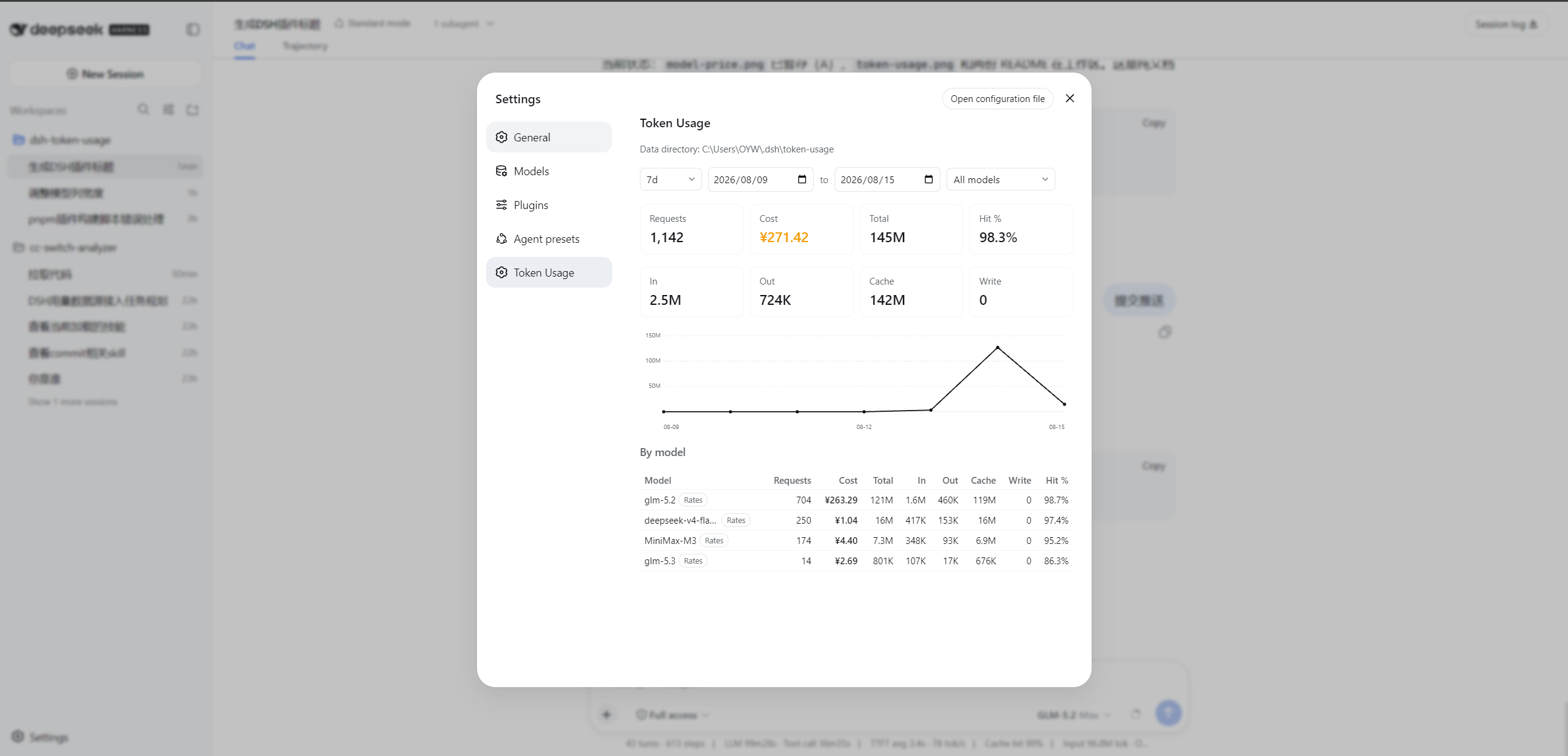
A dsh usage plugin that displays model token usage right in the Web UI. After installation, open Settings (the gear icon in the sidebar) and you'll find the Token Usage page — summary cards (with cost), a daily total-token line chart, a per-model / per-session breakdown, and per-model pricing dialogs, all filterable by date range and model, exactly as shown in the screenshot above.
Repo: https://github.com/LaoYueHanNi/dsh-token-usage
[!IMPORTANT]
GitHub direct installs have ended — the repository no longer carries prebuilt output. Install from npm instead:dsh plugin --profile web add @laoyuehanni/dsh-token-usageUpgrading from a legacy
github:install (≤ 0.3.7, package namedsh-token-usage)? An in-placeupdatefails to load — remove the old name first, then add again. Usage data under$DSH_HOME/token-usage/carries over untouched.
Features
- Live recording: every provider-billed model call is recorded as it happens — tokens, cost, model, session — context-compaction calls included.
- Web stats page: filters (date range + model +
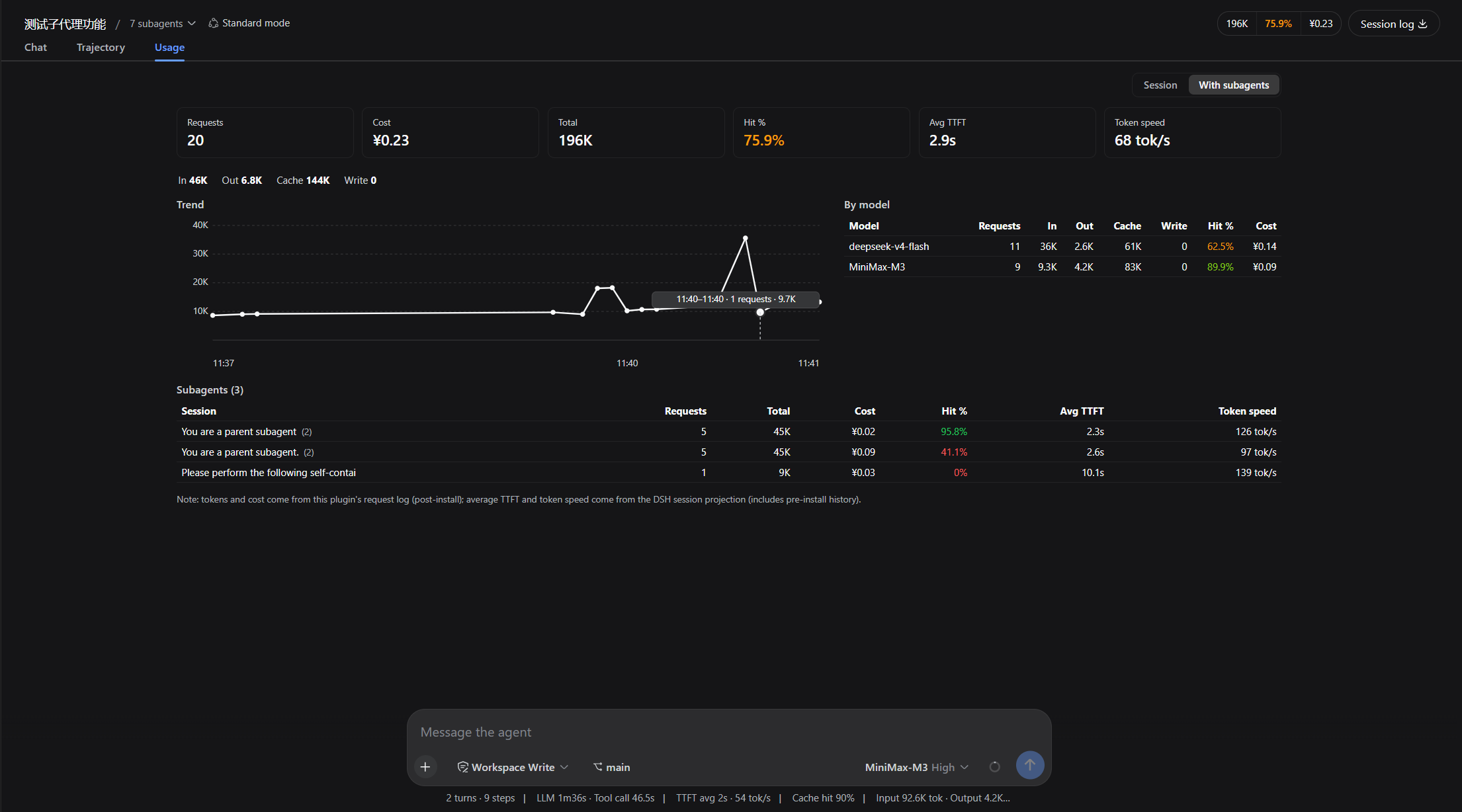
1d/7d/30dshortcuts), summary cards, daily trend chart (hover a day for its total), per-model table. The table block toggles between per-model / per-session: the session table groups by working directory (switchable to a flat list), sorts by total tokens / cost / recent activity on header click, and Ctrl+click on a session row jumps straight to that session's usage tab. - Session usage tab: the conversation pane gains a Usage view tab (beside Chat / Trajectory) with the active session's dashboard — six stat cards (successful requests with a failure pill, cost, cache hit rate, average time-to-first-token, generation throughput, total tokens), a 4-bucket token strip, an hourly trend chart, and a per-model table. A scope switch toggles Session / With subagents, and the subagent table drills into each child and back. Hovering the failure pill breaks failures down per class (rate limited, server error, context exceeded, …).
- Cost figures & model pricing: per-request cost is computed live from per-model rates (¥ per million tokens); unpriced models warn and count as ¥0. Every priced model's name carries a rates button opening its full price table, and the filter row carries a pricing table entry opening an overview of every model in the cloud feed — searchable, with simulated billing and expandable effective rates. Rates sync from the cloud feed on every startup — see Model pricing.
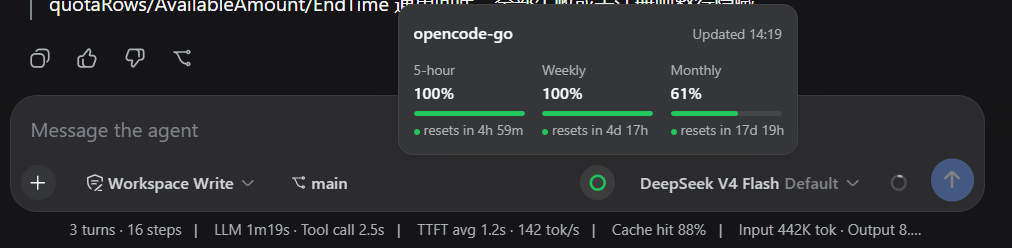
- Provider quota: an input-bar button (left of the model chip) shows the selected provider's remaining quota. See Provider quota.
- History backfill: the first startup syncs requests that happened before installation (idempotent); unreadable session logs are skipped and counted, never fatal to the sync.
Model pricing
Costs are billed per record at its own timestamp, and a rates update re-prices the whole history instantly. The single source is a cloud mirror auto-synced on every startup — pricing corrections belong upstream in the model-price-table feed, so every user benefits at once. A hand-edited pricing.json is no longer read; if you maintain one it is silently ignored after upgrading (the file is left on disk). Upgrading from 0.4.1 or earlier to 0.4.2 triggers a one-time full rebuild of the usage rollup the first time the stats page is read — the larger the history, the longer it takes; this is expected. Broken mirrors degrade the affected models to unpriced without breaking the stats page. Default location: ~/.dsh/token-usage/. Billing rule chain, cloud feed format, and self-hosted mirror URLs: docs/pricing.md.
Configuration
Data directory
Editable on the web card (Settings → Plugins → Token Usage): saving an absolute path takes effect immediately — history migrates automatically, no restart, no manual move. Blank keeps the default ~/.dsh/token-usage/. A save is refused while a conversation is in progress; wait for it to end, then save again. Or set it directly:
plugins:
  token-usage:
    path: D:/data/token-usage   # default: ~/.dsh/token-usage/
Pricing region
The pricing mirror follows your region: Gitee by default (fast inside mainland China) or the GitHub mirror of the same table — pick once on the web card's Pricing region dropdown or via config. The pick also drives the display currency (¥ RMB vs $ USD at the table's exchange rate).
plugins:
  token-usage:
    pricingRegion: overseas   # default: domestic
Provider quota
The input-bar button follows the currently selected provider and opens a panel with remaining quota (the same API key as inference):

| Provider | Shows |
|---|---|
| Zhipu GLM Coding Plan (CN / international) | 5-hour, weekly (some plans also monthly) |
| Kimi For Coding | 5-hour, weekly |
| MiniMax Coding Plan (CN / international) | 5-hour, weekly |
| OpenCode Go | 5-hour, weekly, monthly |
| DeepSeek (official) | ¥ account balance |
| OpenRouter | $ remaining credits |
Unsupported providers hide the button; a failed query can be retried from the panel. On by default; turn it off with quota.enabled: false. Not supported yet: Volcengine, ZenMux, Zhipu Team plan, Claude / Codex / Gemini / Grok official subscriptions, GitHub Copilot.
Install
dsh plugin --profile web add @laoyuehanni/dsh-token-usage
The package declares
dsh.bundle, soaddwires the plugin into the profile automatically — installs work out of the box, and the first startup backfills pre-install history.
Update
dsh plugin --profile web update @laoyuehanni/dsh-token-usage
Remove
dsh plugin --profile web remove @laoyuehanni/dsh-token-usage
Data files under $DSH_HOME/token-usage/ are kept — delete them manually if you no longer need them.
Development
Build once, install a symlink, iterate:
npm install
npm run build && npm run build:client
dsh plugin --profile web add link:D:/plugins/dsh-token-usage
Rebuild and restart dsh web to apply changes (npx tsdown --watch in the plugin directory hot-reloads the client). No prepare script by design — lib/ never enters the repo; npm publish builds it fresh into the tarball.
Temporary host-only mount (this launch only, no profile changes): copy cordis.example.yml to cordis.yml, point name at the absolute file:// URL of your lib/index.js, then dsh web --patch <plugin-dir>/cordis.yml. Data recording works in this mode; for UI work use the link: install above.
安装
装一次目录插件,之后本站所有插件都能让 DeepSeek Harness 自动找、自动装:
dsh plugin add dshbase-catalog然后对 agent 说「帮我装 dsh-token-usage」,它会在目录里找到并自动安装。文档:dshbase-catalog · 已验证场景包。
Web profile:
dsh plugin --profile web add dsh-token-usageHeadless(CLI)profile:
dsh plugin --profile headless add dsh-token-usage包信息
npm:dsh-token-usage · 版本 0.1.0 · 实测环境 dsh 0.1.0-rc.6
实测报告
端到端验证通过:dsh 0.1.0-rc.6 上 L1 安装 + L2 加载 + L3 运行问答。
使用场景
给 agent 一套记忆、知识库或检索层,让它不再跨会话丢上下文。
适合谁
跑长项目、想让 agent 记住决策、文档和偏好而不用每次重讲的人。
二次开发建议
记忆/检索后端是缝——插新存储、调蒸馏策略,或加引用与审计轨迹。
分享徽章
把这枚徽章粘进 README——它会链回本页,实测状态变化时自动更新:

[](https://dshbase.com/zh/plugins/dsh-token-usage/)<a href="https://dshbase.com/zh/plugins/dsh-token-usage/"><img src="https://dshbase.com/badges/dsh-token-usage.svg" alt="dshbase 实测可装"></a>