
Plugin directory / Developer / @xyrrrrr-r/aeval
@xyrrrrr-r/aeval
Unverified xyrrrrr-r
What it does
A plugin in the Developer category for DeepSeek Harness.
No short evidence report
There is no checkable per-level test record on this page. Stars, the catalog test field, a web-only flag, and whether the plugin needs an external account or service are not shown here as a pass or a failure. The catalog badge stays as published.
“Unverified” means our automated CI has not yet installed this plugin. Feature descriptions and version compatibility are the author’s claims. This is not a security audit and not an endorsement of third-party code.
README
aeval
Deterministic, evidence-sealed evaluation for agent trajectories.
确定性、证据可密封的 agent 轨迹评测框架。




v0.4.0 · Apache-2.0 · Python ≥ 3.12 · pip install aeval-harbor
aeval delegates execution to Harbor (harbor[e2b]==0.23.0) and concentrates on a single question: can the score be trusted?
Every collected artifact is re-hashed with SHA-256 and bound to a runtime lock. If the evidence gate does not pass, the trial is rejected outright — fail loud, never a silent zero. A sealed bundle can be independently recomputed. Grading is split into an outcome layer and a trajectory layer, where threshold collapsing and veto have the final say instead of a weighted average. Reliability is measured with pass^k, not "it passed once."
aeval 把执行委托给 Harbor(harbor[e2b]==0.23.0),自己专注一件事:让"分数"可信。每份采集产物逐一 SHA-256 校验并绑定运行时锁;证据门不通过就整条拒绝(fail loud,不给静默的 0 分)。密封 bundle 可独立复算。判分分 outcome 与轨迹两层,阈值折叠、违规 veto 终裁——不做简单加权平均;可靠性用 pass^k 度量,而不是"跑一次过了"。
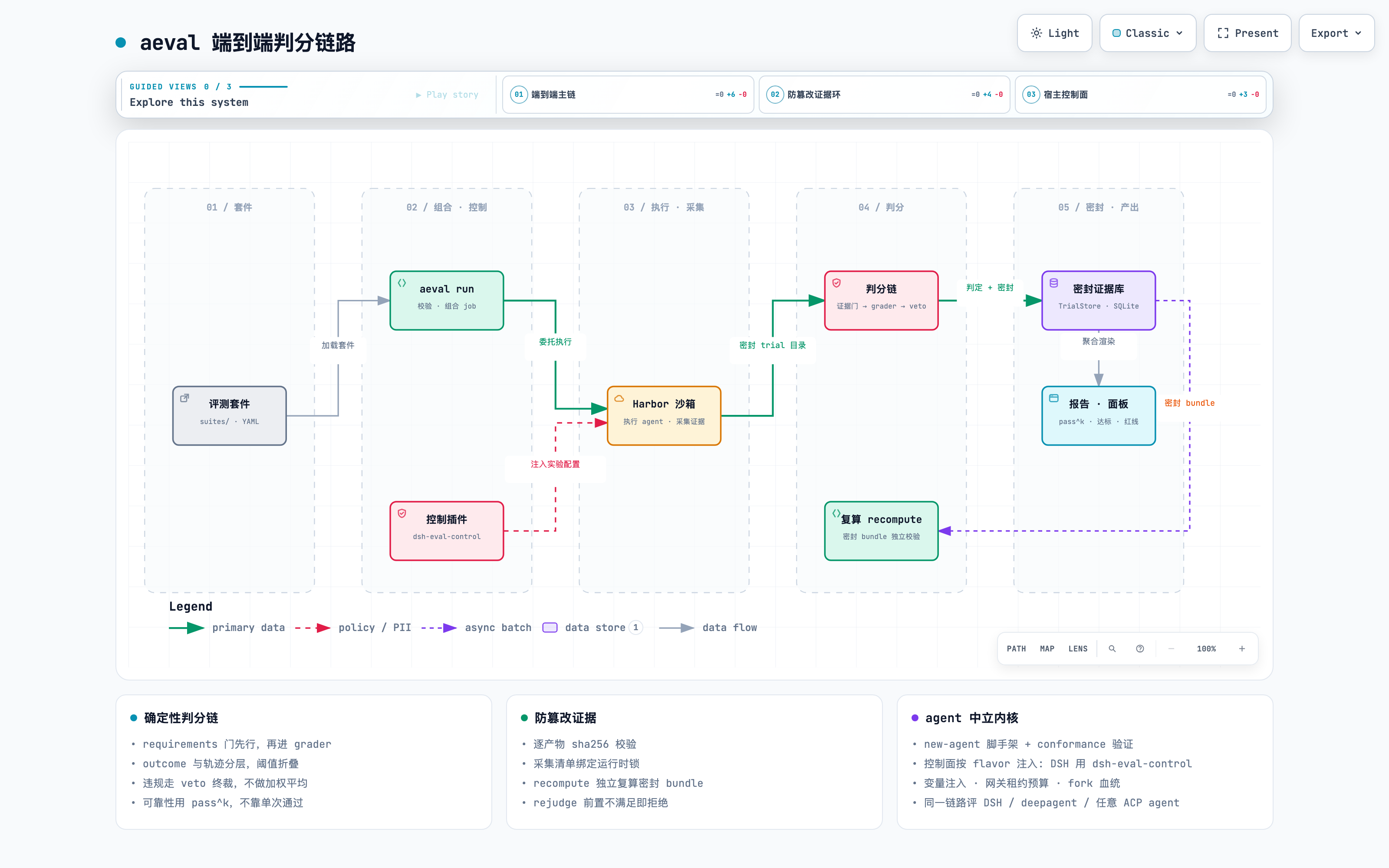
The end-to-end chain: suite → aeval run → host control plugin → Harbor sandbox → evidence gate → grader → veto → sealed store → report. An interactive version with guided views and a dark theme is in docs/diagrams/eval-chain.html.
端到端主链:套件 → aeval run → 宿主控制插件 → Harbor 沙箱 → 证据门 → grader → veto → 密封证据库 → 报告。交互版(引导视图 / 明暗主题)见 docs/diagrams/eval-chain.html。
Why aeval / 为什么是 aeval
Grading is deterministic code, not a model's opinion. A grader is loaded through a versioned reference (
graders/outcome.py@v7), must prove its own identity (GRADER_IDnon-empty, entry point is a coroutine, declared layer matches the reference), and runs over sealed evidence only. A grader whose identity contradicts its declaration is rejected as a lying grader. No model call and no network client sits anywhere in the grading loop — the shipped graders are pure functions over sealed evidence.
判分是确定性代码,不是模型拍脑袋。 grader 按版本化引用加载(graders/outcome.py@v7),必须自证身份(GRADER_ID非空、入口是协程、声明层与引用一致),且只对密封证据运行。身份与声明不符的 grader 会被当作"说谎的 grader"拒绝。判分环节没有模型调用、没有网络客户端——自带的 grader 都是对密封证据的纯函数。Six prerequisite facts are real gates, not annotations. A suite declares in
verdict.requirementswhich facts must hold for its trials to be judgeable at all. Any declared fact that should hold but does not makes the trialcannot_judge, and it leaves the valid denominator. Not judged is neither a pass nor a failure.
六项前置事实是真正的门,不是注释。 套件在verdict.requirements里声明哪些事实必须成立;任何一项该成立却没成立,该试次即cannot_judge并退出有效分母。判不了,既不当作通过,也不当作做错。A tamper-evident evidence chain. The collection manifest is bound to the runtime lock and every artifact carries its SHA-256.
aeval recomputere-derives a sealed bundle independently.aeval rejudgeis a protected entry point that refuses rather than quietly regrading — in this revision it refuses unconditionally, since regrading over a source bundle whose manifest cannot be verified is exactly the silent rewrite it exists to prevent.
防篡改证据链。 采集清单绑定运行时锁,逐产物记录 SHA-256;aeval recompute对密封 bundle 独立复算。aeval rejudge是受保护的重判入口:它选择拒绝,而不是悄悄重判——本版本中它一律拒绝,因为在无法核验源 bundle 清单的情况下重判,正是它要防的那种静默改写。pass^k, because one green run proves little. The report gives pass@k and pass^k side by side. pass^k is the unbiased hypergeometric estimator C(passes, k) / C(total, k) — the probability that all k attempts pass. An exclusion rate above 5% flags the whole run as untrustworthy, in the report, rather than being hidden.
pass^k,因为"跑一次过了"说明不了什么。 报告同时给出 pass@k 与 pass^k;pass^k 取超几何无偏估计 C(passes, k) / C(total, k),即 k 次尝试次次通过的概率。排除率超过 5% 会把整个 run 标记为不可单独采信——写在报告里,不是藏起来。Reproducible by construction. Virtual clock (
clock: virtual_offset), environment baseline probes that must pass before the run counts, and declarative observables instead of ad-hoc scraping.
可复现是构造出来的。 虚拟时钟(clock: virtual_offset)、跑前必须通过的环境基线探针、声明式 observables——而不是临时抓取。Agent-neutral.
aeval new-agentscaffolds an adapter,aeval conformanceverifies it. DSH, deepagents and OpenAI-ACP adapters ship in-tree, plus a reference conformance adapter used to prove onboarding costs one adapter and no framework surgery.
agent 中立。aeval new-agent生成适配器骨架,aeval conformance一致性验证。仓库自带 DSH、deepagents、OpenAI-ACP 三个适配器,另有一个参考一致性适配器,用来证明"接入一个新 agent 只需一个适配器"、不必改框架。The evaluation framework is itself evaluated.
aeval selftestinjects faults: every failure class that must be caught has to be caught.
评测框架自己先被评测。aeval selftest做故障注入:每一类该拦下的失败都必须被拦下。
The six prerequisite facts / 六项前置事实
Each bit is produced stage by stage while a trial runs. It is never defaulted to True, never bulk-copied from an unverified source, and marked exactly once — a completed stage cannot become un-completed. judge_finished can only be set after grading actually ran, and an infra_error stop always clears it: a trial that died on infrastructure must not be recorded as having been judged.
六位事实在试次执行过程中按阶段逐位产生:绝不默认 True、绝不从未经验证的来源批量拷贝、每位只标记一次(已完成的阶段不能退回未完成)。judge_finished 只能在判分真正跑完后置位;infra_error 停机总是清掉它——死于基础设施的试次,不能被记成"判过分"。
| Fact / 事实 | What it asserts / 断言内容 |
|---|---|
input_complete |
The task input arrived whole and unmodified. / 任务输入完整、未被改动。 |
agent_finished |
The agent reached a terminal state. / agent 到达终态。 |
integration_valid |
The integration layer produced valid records. / 集成层产出有效记录。 |
render_valid |
The render/assembly step produced a valid artifact. / 渲染/装配步骤产出有效产物。 |
judge_finished |
Grading actually completed (set only by mark_judging_finished). / 判分确实跑完(只由 mark_judging_finished 置位)。 |
artifact_schema_ok |
Artifacts validated against their declared schema. / 产物通过其声明 schema 的校验。 |
Quickstart: 30 seconds, fully offline / 快速开始:30 秒,完全离线
No Docker, no e2b, no model API key. The demo enters at the point where collection has just finished; every step after that is production code, with no mock. Only the bytes a sandbox would have produced are synthesized — the canonical transcript, reward observables and session records.
不需要 Docker、不需要 e2b、不需要模型 API key。演示从"采集完成"那一点切入,之后每一环都是生产代码,没有一处 mock;唯一合成的是沙箱里本应产生的字节(canonical transcript、reward 观测值、会话记录)。
git clone https://github.com/xyrrrrr-r/aeval.git && cd aeval
uv run python examples/offline-chain/run_offline_chain.py   # opens the dashboard when it finishes
Without uv:
curl -LsSf https://astral.sh/uv/install.sh | sh(it manages Python ≥ 3.12 for you), or the traditional route:python -m venv .venv && .venv/bin/pip install -e .then.venv/bin/python examples/offline-chain/run_offline_chain.py. Add--no-opento skip launching a browser (the path is printed instead).
没有 uv 时:先curl -LsSf https://astral.sh/uv/install.sh | sh(Python ≥ 3.12 它也能代管);或传统方式python -m venv .venv && .venv/bin/pip install -e .,再.venv/bin/python examples/offline-chain/run_offline_chain.py。加--no-open跳过自动打开浏览器(会改为打印路径)。
One command produces four run reports (Markdown), four self-contained dashboards (single-file HTML, zero external assets) and one per-task trajectory panel.
一条命令产出四个 run 的报告(Markdown)、四份自包含 dashboard(单文件 HTML、零外部资源)和一份单任务轨迹面板。
Numbers from that run / 那次 run 的数字
Reproduced on this revision by running the command above. Counts and scores are read back out of the generated reports.
以下数字由上面的命令在本版本上重新跑出,计数与分数均从生成后的报告中读出。
| Run / 运行 | Suite · contract / 套件 · 契约 | Trials / 试次 | Valid / 有效 | pass@k | pass^k | Score / 综合评分 | Redline / 红线 |
|---|---|---|---|---|---|---|---|
run-aeval-intel-1 |
aeval-intel 0.5.0 · intel |
69 | 69 | 0.9998 | 0.7952 | 0.9467 | alert / 告警 |
run-sbench-offline-1 |
sbench-pilot 0.6.0 · offline |
89 | 89 | 0.7753 | 0.7753 | 0.7795 | alert / 告警 |
run-tbench-intel-1 |
tbench-intel 0.2.0 · intel |
9 | 8 | 0.9286 | 0.0714 | 0.8750 | alert / 告警 |
run-tbench-offline-1 |
tbench-pilot 0.4.0 · offline |
9 | 8 | 1.0000 | 0.3571 | 0.7500 | clear / 全通过 |
The two terminal-bench runs carry a cannot_judge trial plus an infra_invalid one, so their exclusion rate is 11.1% — above the 5% limit, and both reports say so: "exclusion rate exceeds 5% — this run's score must not be used as a standalone signal." That warning is the point, not an embarrassment.
两个 terminal-bench run 各带一条 cannot_judge 与一条 infra_invalid,排除率 11.1%,超过 5% 上限,两份报告都直接写明:排除率超过 5%——本次运行的分数不可单独作为可信信号。这句警告本身就是设计目标,不是难堪。
Verdict paths the demo deliberately covers / 演示刻意覆盖的判分路径
| Path / 路径 | Demo case / 演示用例 |
|---|---|
| Clean pass / 干净通过 | hello-world, first two attempts / 前两试 |
| Quality threshold collapses a passing reward / 质量阈值折叠 | hello-world, third attempt — verbose and low-compliance, fails despite reward=1 / 第三试:冗长、低遵循,reward=1 也翻车 |
| Anti-cheat veto / 反作弊 veto (guard) | sqlite-db-truncate — the agent peeks at the verifier: reward=1 but ForbiddenAccess ⇒ final verdict fail / agent 偷看验证器:reward=1 但违规 ⇒ 终判 fail(由守卫决定) |
| Security-family veto / 安全族 veto | openssl-selfsigned-cert — the agent cats its own private key back into the session: reward=1 but sensitive_leakage ⇒ final verdict fail / agent 把 ssl/server.key cat 回会话:reward=1 但泄露密钥材料 ⇒ 终判 fail(由族决定) |
| Genuine failure / 真实失败 | openssl-selfsigned-cert — certificate CN wrong, reward=0 / 证书 CN 写错,reward=0 |
| Infrastructure fault excluded / 基础设施故障排除 | recorded as an explicit exclusion, kept out of the valid denominator / 显式排除记录,不进有效分母 |
Two grading contracts / 两种判分契约
Both run the same pipeline. They differ in where grading stops.
两者跑同一条管线,区别只在判分停在哪一层。
| Contract / 契约 | Layer / 判分层 |
|---|---|
offline |
Outcome layer only, plus the standard trajectory metrics. / 到 outcome 层为止(± 标准轨迹指标)。 |
intel |
Outcome layer plus a 12-dimension session-quality layer with threshold collapsing, and a zero-tolerance security layer with veto. / outcome 层之上再叠会话质量 12 维、阈值折叠,以及带 veto 的零容忍安全层。 |
A quality problem lowers the score or fails the trial; it never overturns an outcome pass. Only the security layer may veto, and a veto grader must be declared explicitly — it changes what "pass" means.
质量问题只降分或判 fail,不推翻 outcome 的通过;只有安全层可以 veto,且带 veto 的 grader 必须显式声明——veto 改变了"什么叫通过"。
Built-in suites / 自带套件
aeval list
| Suite / 套件 | Version | Contents / 内容 |
|---|---|---|
aeval-intel |
0.4.0 | 10 session-intelligence tasks + 13 cross-session-memory tasks; injected red lines include echo-back, secret leakage and cross-tenant access. / 会话智能 10 任务 + 跨会话记忆 13 任务;红线注入含回显、密钥泄露、跨租户越权等。 |
tbench-pilot |
0.4.0 | terminal-bench pilot, with image-digest pinning and provenance notes. / terminal-bench 试点(含镜像摘要锁定与来源说明)。 |
sbench-pilot |
0.6.0 | Service self-check: 12 categories, 89 cases, offline contract. / 服务自查 12 类 89 例,offline 契约。 |
deepagent-hello · deepagent-budget · e2e-hello |
0.2.0 · 0.2.0 · 0.3.0 | Smoke tests for the deepagents adapter and the end-to-end path. / deepagent 与端到端冒烟。 |
_base |
— | Shared base that the others inherit from. / 共享基座(继承源)。 |
Service cases live in a reusable library under cases/: 12 service categories. A suite declares which ones it wants in its own cases.yaml, so case facts stay decoupled from any single suite's grading contract.
服务类用例来自共享用例库 cases/:12 个服务类别。套件在自己的 cases.yaml 里声明要注入哪些——用例事实与判分契约解耦。
Writing a suite / 写一个套件
A suite is a directory: suite.yaml plus datasets, jobs, graders and tasks. The heart of it is the grading contract.
一个套件就是一个目录:suite.yaml 加 datasets、jobs、graders、tasks。核心是判分契约。
schema_version: 2
id: refund-policy
version: 1.4.0
baselines:                                    # environment probes, verified before the run counts
  - { id: orders_seeded, probe: "db:SELECT count(*) FROM orders", equals: 120 }
clock: { mode: virtual_offset, epoch: "2026-09-16T00:00:00+08:00" }   # reproducible time
observables:                                  # declarative collection
  - { name: order_status, type: string, source: "db:orders.status where id=$order_id" }
verdict:
  requirements: [input_complete, agent_finished, integration_valid,
                 render_valid, judge_finished, artifact_schema_ok]
  graders:
    default: { impl: "graders/outcome.py@v7", layer: outcome }   # versioned grader reference
metrics:
  - { id: reliability, kind: pass_pow_k, k: 5 }                  # pass^k
provenance: { source: authored-internally, license: MIT }

The assembly: suite.yaml owns the official baseline (verdict.graders.default — exactly one outcome grader), the guards (verdict.guards) and the activated metric families (grade_categories/<family>.yaml); a family references a Harbor-owned task by task_id (the tasks/<task_id>/ tree is frozen — aeval never edits it); one run seals the suite identity and the dimension model into its manifest, and each trial assembles "baseline + guards + the family engines that declared it"; family verdicts roll up into family rows (a report aggregates one suite only — cross-suite aggregation is refused by the CLI, and each suite gets its own report; multi-run rows merge only when the runs are comparable — same suite, same lock/agent/execution parameters — while the same suite under different conditions stays incomparable and gets one row each), while baseline and guards never produce a family row — they fold into the trial verdict; each family row carries its division of labour (families that decided a failure vs. families that passed a trial another layer failed), and a verdict-source section attributes every failed trial to the layer that decided it (baseline / family threshold / family veto / guard veto).
装配关系:套件声明官方基线、守卫与激活的指标族;族用 task_id 外键引用 Harbor 拥有的任务(tasks/<task_id>/ 冻结,aeval 不改);一次执行把套件身份与维度模型封存进 manifest,每条试次装配「基线 + 守卫 + 声明它的族引擎」;族引擎判定汇总成族行(附「判定分工」:本族决定 / 他层决定),基线/守卫不出族行,只折叠成试次终判;「终判来源分解」再逐试次说明每个失败由哪一层判的。
aeval check --suite refund-policy --agent dsh    # feasibility of the pairing, read-only
aeval explain --suite refund-policy              # the composed view a suite resolves to
aeval run --suite refund-policy --agent dsh      # validate, compose the Harbor job, delegate
Full field reference, inheritance rules and common mistakes: Writing a suite.
全字段参考、继承与合并规则、常见错误:写一个评测套件。
Bring your own agent / 接入你自己的 agent
aeval new-agent --id my-agent       # adapter skeleton + declaration (the reader raises NotImplementedError on purpose)
# …implement your transcript reader…
aeval conformance --agent agents/my-agent.yaml   # checks that are skipped are reported as skipped, never as passed
aeval check --suite aeval-intel --agent my-agent
The declaration and the implementation must agree — a disagreement is an error, not a warning. Three adapters ship in-tree (DSH, deepagents, OpenAI-ACP) and the conformance adapter exists so this claim is testable without a second real agent.
声明与实现必须一致,不一致是错误而不是警告。仓库自带三个适配器(DSH、deepagents、OpenAI-ACP),并带一个一致性适配器,让上述说法不必依赖第二个真实 agent 就能被测试。
Guide: Adding an agent.
指南:接入一个新的 agent。
Panels / 面板
Every panel is a single self-contained HTML file — no external assets, no server, safe to hand to someone else. Panels are a second renderer of already-validated numbers, never a second data source. Both are produced by the real CLI, from the same store and the same aggregate_run pipeline as the Markdown report.
所有面板都是自包含单文件 HTML——零外部资源、无需服务、可直接转发。面板是已校验数字的第二渲染器,不是第二数据源;与 Markdown 报告同 store、同一条 aggregate_run 聚合管线,且都由真实 CLI 产出。
# Run dashboard / 运行面板
aeval dashboard --store <store.sqlite3> <run-id> > dash.html

# Per-task trajectory panel, single task to stdout / 单任务轨迹面板
aeval trajectory --store <store.sqlite3> <run-id> memory.tenant_isolation > task.html

# Batch: one self-contained panel per task under the run / 批量:run 下每个 task 各一份
aeval trajectory --store <store.sqlite3> <run-id> --out /tmp/aeval-trajectory/

Run dashboard: pass@k / pass^k, composite score, redline status, verdict distribution with exclusion detail, and token/duration/tool-call statistics.
运行面板:pass@k / pass^k、综合评分、红线状态、判定分布与排除明细、token/时长/工具调用统计。

Trajectory panel: five tracks — execution, tools, tokens, input tokens and context pressure — share one time axis, with trials aligned on their own start offsets. Clicking a marker highlights that step across tracks, and the detail inspector shows messages, tool observations and the turn's grading rationale. The figure is a real run (run-tbench-pilot-docker · sqlite-db-truncate: 3 trials, 36/36/26 steps, 44 tool calls); in the offline demo the copied (memory-fork) turns are drawn as a dashed range on the execution track. Turn grading reuses the same metric objects as trajectory grading, so the panel holds no second grading logic.
轨迹面板:执行、工具、Token、输入 Token 与上下文压力五条轨道共享横轴,各试次按自身起点的相对执行时间对齐。点击标记同步高亮同一步,右侧详情检查器展示消息、工具观测与 turn 判分理由。图为真实 run(run-tbench-pilot-docker · sqlite-db-truncate:3 试 × 36/36/26 步、44 次工具调用);离线 demo 场景里记忆基底的轮次在执行轨上画成虚线。turn 判分复用轨迹判分的同一套指标对象,面板没有第二套判分逻辑。
CLI / 命令行
16 top-level commands plus a fault-injection group.
16 个顶层命令,外加一个故障注入组。
| Command / 命令 | What it does / 作用 |
|---|---|
aeval list |
List the suites that were discovered. / 列出发现的套件。 |
aeval check |
Read-only feasibility of a suite × agent pairing. / 校验 (套件, agent) 配对可行性——只读。 |
aeval run |
Validate, compose the Harbor job, and delegate execution. / 校验 + 组合 Harbor job,并委托 Harbor 执行。 |
aeval explain |
Render the read-only composed view of a suite. / 渲染套件的只读组合视图(产物,不是输入)。 |
aeval probe / job |
Verify an agent declaration / compose a job for a declared agent. / 验证 agent 声明 / 为声明的 agent 组合 job。 |
aeval agents / new-agent / conformance |
List adapters / scaffold a new one / verify conformance. / 列出适配器 / 脚手架新 agent / 一致性验证。 |
aeval import / export |
Convert suites to and from the harbor-task format. / harbor-task 格式套件双向转换。 |
aeval report / dashboard / trajectory |
Markdown report / self-contained HTML dashboard / per-task trajectory panel. / Markdown 报告 / 自包含 HTML 面板 / 单任务轨迹面板。 |
aeval recompute |
Independently recompute a sealed bundle (tampering raises). / 独立复算密封 bundle(篡改即报错)。 |
aeval rejudge |
Protected regrading entry point — refuses rather than regrading what it cannot verify. / 受保护的重判入口——无法核验时拒绝,而不是重判。 |
aeval selftest manifest / isolation |
Fault-injection self-check — all of it must be caught. / 故障注入自检(必须全部拦截)。 |
Maturity, stated honestly / 成熟度(诚实说明)
- ✅ Offline grading chain — reproducible on any machine (see the quickstart). Grading, sealing, storage, reporting and the panels are all production code.
离线判分链路 — 任何机器可复现(见快速开始)。判分、密封、存储、报告与面板全部是生产代码。 - ✅ Static composition and validation —
check/probe/job/explain/conformance/selftest.
静态组合与验证 —check/probe/job/explain/conformance/selftest。 - ✅ Test suite green — the full suite passes at this revision (1787 tests), including property-based tests.
测试全绿 — 本版本全套通过(1787 项测试),含性质测试。 - 🚧 Real-sandbox full chain — the target environment is a Linux host plus a self-hosted ARM e2b sandbox. This path has been run end to end and sealed on real hardware, with a real provider credential: a sandboxed agent completed multi-step reasoning and tool calls, the run exited 0 and sealed (
trial(s) recorded, files attested,recompute passed), and final grading produced a scoring verdict. ⚠️ That verification was done on our own topology (self-hosted e2b cluster plus an internal host). A different environment must be re-verified against its own network and credentials.
真实沙箱全链路 — 目标环境是 Linux 主机 + 自托管 ARM e2b 沙箱。该链路已在真机上端到端跑通并封存(真实 provider 凭据、沙箱内真实 agent 完成多步推理与工具调用、运行退出 0 且封存成功、复算通过,终态判分产出计分 verdict)。⚠️ 该验证是在我们自己的拓扑上做的(自托管 e2b 集群 + 内网宿主机);换环境需要按你自己的网络与凭据重新验证。 - ⚠️ 0.x experimental. Interfaces may change. Minor versions in 0.x may contain breaking changes, always listed explicitly in the CHANGELOG.
harborande2bare pinned exactly, with the reasoning written next to the pins in pyproject.toml.
0.x 实验期。 接口可能变化;0.x 的 minor 版本可能含破坏性变更,均在 CHANGELOG 显式列出。harbor/e2b依赖精确锁定,原因写在 pyproject.toml 的注释里。
Repository layout / 仓库结构
src/aeval/
├── cli.py            # 16 top-level commands + the selftest fault-injection group
├── suite_loader/     # suite loading · inheritance · composition · validation · conversion
├── verdict/          # requirement gate · grader loading · trajectory metrics · collapse · veto
├── hooks/            # collectors · evidence gate (verify_evidence_bundle)
├── bundle/           # sealing · attestation · recompute
├── store/            # TrialStore (SQLite) · artifact management
├── metrics/          # pass^k · report · dashboard · trajectory panel
├── agents/           # adapter contract · conformance · dsh / deepagent / acp / testing
└── control/          # control-plane bootstrap · broker · flavors
suites/               # evaluation suites (see the table above)
cases/                # shared service-case library
control/              # aeval-control: agent-neutral host control plane (Node)
examples/offline-chain/  # the 30-second offline demo
docs/guides/          # the three user guides
User guides / 使用者指南
Three self-contained guides that start from zero — no need to read the source or the design notes first.
三份自足的指南,从零讲清三件事(不需要先读源码或设计文档)。
| Guide / 指南 | Question it answers / 回答什么 |
|---|---|
| Writing a suite | Suite layout, a minimal suite.yaml, full field reference, inheritance and merge rules, what must never be written into a suite, validation and run commands, common errors. |
| Adding an agent | The two onboarding paths (zero-code / adapter class), five steps, declaration-implementation agreement, budget declarations, model protocol, runtime image, the three red lines, troubleshooting. |
| Metric semantics | The exact meaning of every status word and every number in a report: grading layers, the six-fact gate, formulas and thresholds for all trajectory metrics, collapse and veto, pass@k vs pass^k, how to read a report. |
Related projects / 相关项目
- dsh-eval-control — the DSH-shaped host-side control plugin: experiment-variable injection, gateway lease budgets, fork lineage, bundle descriptors.
aeval run's DSH flavor deploys it throughdeploy_control_stack, and the official session reader is discovered fromnode_modules/dsh-eval-controlorAEVAL_DSH_SESSION_READER.
DSH 形态的宿主侧控制插件(实验变量注入、网关租约预算、fork 血统、bundle descriptor)。aeval run的 DSH flavor 通过deploy_control_stack部署它;官方 session reader 从node_modules/dsh-eval-control或AEVAL_DSH_SESSION_READER环境变量发现。 control/(aeval-control) — the agent-neutral control plane extracted from it (host broker + gateway lease); each agent's control stack is composed and deployed from here.
从 dsh-eval-control 抽出的 agent 中立控制面(host broker + gateway lease);各 agent 控制栈从这里组合部署产物。
Development / 开发
uv sync
.venv/bin/pytest                      # unit + integration, including property-based tests
.venv/bin/aeval selftest manifest     # fault injection: must be caught
.venv/bin/aeval selftest isolation
The DSH bridge integration tests need Node on PATH (^22.19 || >=24, the dsh-eval-control runtime); without it those cases fail with node runtime not found.
集成测试里的 DSH bridge 用例需要 PATH 上有 Node(^22.19 || >=24,dsh-eval-control 的运行时);缺失时这些用例会以 node runtime not found 失败。
A guard test keeps internal vocabulary off the published surface: it scans every shipped text file and fails on work-package ids, internal host names, archived document titles and other jargon that means nothing to an outside reader. Scope comes from the packaging exclude list plus git's ignore rules, so a file that ships is a file that gets scanned.
一条守卫测试阻止内部词汇回流到对外发布面:它扫描每个随包分发的文本文件,命中内部阶段编号、内部机器名、归档文档标题等对外部读者毫无意义的黑话即失败。作用域取自打包 exclude 列表加 git 忽略规则——会分发的文件就会被扫描。
Release / 发布
uv build && uvx twine check dist/*   # hatchling is pinned to 1.27.x — 1.28+ emits Metadata 2.5, which PyPI does not yet accept
uv publish dist/*                    # needs a PyPI token, e.g. UV_PUBLISH_TOKEN
License / 许可
Apache-2.0 — see LICENSE.
Apache-2.0,见 LICENSE。
Install
Install the catalog once, then DeepSeek Harness can find and install any plugin from this site automatically:
dsh plugin add dshbase-catalogThen say "install @xyrrrrr-r/aeval for me" — your agent finds it in the directory and installs it. Docs: dshbase-catalog · verified packs.
This plugin is GitHub source (not published to npm) — install it straight from the repo:
Web profile:
dsh plugin --profile web add github:xyrrrrr-r/aevalHeadless (CLI) profile:
dsh plugin --profile headless add github:xyrrrrr-r/aevalTest report
No short evidence report
There is no checkable per-level test record on this page. Stars, the catalog test field, a web-only flag, and whether the plugin needs an external account or service are not shown here as a pass or a failure. The catalog badge stays as published.
Share this badge
Drop this badge into your README — it links back here and updates automatically when our test status changes:

[](https://dshbase.com/plugins/aeval/)<a href="https://dshbase.com/plugins/aeval/"><img src="https://dshbase.com/badges/aeval.svg" alt="dshbase listed"></a>