
Plugin directory / Developer / deepseek-harness-reliability-governor
deepseek-harness-reliability-governor
Verified · install-tested on dsh chenjie1129
What it does
Evidence-gated completion and trusted code verification for DeepSeek Harness agents
Works — verified, early-stage project
Evidence-gated completion and trusted code verification for DeepSeek Harness agents It installs cleanly and boots without issues in our testing. It's early-stage but functional.
“Verified” means our automated CI actually ran dsh plugin add in a clean profile and it booted — nothing more. Feature descriptions and version compatibility are the author’s claims. This is not a security audit and not an endorsement of third-party code.
README
DeepSeek Harness Reliability Governor

Unofficial community project. Public beta testers wanted. Try three to five disposable local tasks and report counterexamples through the 15-minute feedback protocol. False certification, false exhaustion, false abstention, repair regression, brittle checks, and Harness compatibility reports are especially useful.
An opt-in DeepSeek Harness bundle that lets a user review the proposed evidence contract, then changes completion from a model assertion into a deterministic evidence decision.
It does not make an LLM deterministic. It makes a narrower promise: while a reliability contract is active, the agent is steered until observable checks pass, its bounded repair budget is exhausted, or it abstains. Every attempt and terminal outcome is recorded in the durable session log with a content receipt.
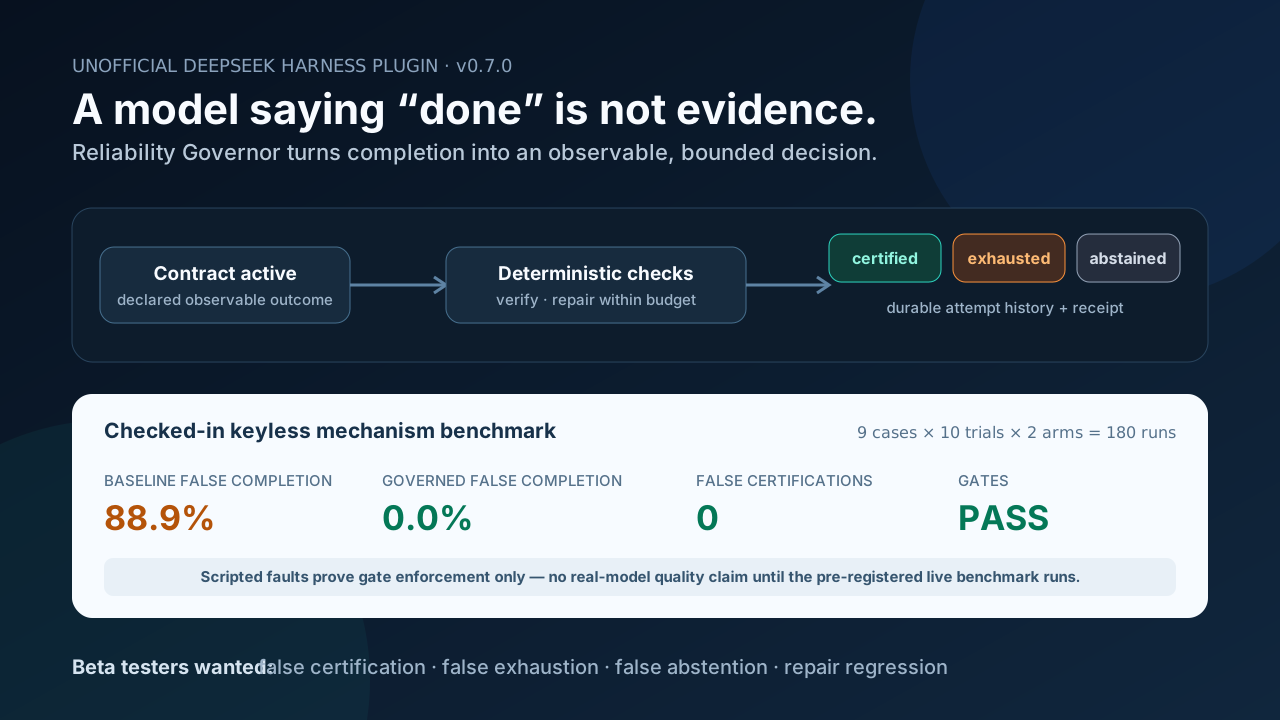
Evidence status
| Evidence | Current result | Claim allowed |
|---|---|---|
| Keyless Harness AgentLoop fault matrix | 9 cases × 10 trials × 2 arms = 180 runs; mechanism gates pass; zero governed false completions and false certifications | The active contract and lifecycle enforce declared deterministic checks under scripted faults. |
| Scripted auxiliary-author boundary tests | Strict parsing, no-tool calls, provenance, and receipt binding pass | The isolation mechanism works with a scripted stream; this is not evidence that a live model writes better contracts. |
| A2UI review boundary tests | Official A2UI v0.9.1 processor accepts the fixed surface; approval, revision, rejection, tampering, fallback, and missing-provider paths fail closed | The exact proposal can require a UI-backed Harness decision before activation; this does not prove the proposal is correct. |
| Pre-registered provider-backed benchmark | 20 tasks × 5 trials × 3 arms planned; not run | No live-model quality, latency, cost, or net-utility claim yet. |
The project is deliberately looking for evidence against its design. See Beta feedback for the independent-oracle protocol and privacy rules.
Why this plugin exists
LLM sampling is only one source of variation. Tool results, environment state, ambiguous success criteria, context, and the model's tendency to self-report completion also vary. Lower temperature cannot prove that a requested outcome happened, and some reasoning modes ignore temperature entirely.
Harness already has goal and iterative workflow plugins, but their current documentation explicitly leaves independent verification to another layer. This plugin fills that generic runtime gap without replacing those workflows.
What it adds
reliability_assess— preview declared-claim coverage, independent-source counts, and brittle-evidence warnings without evaluating task output.reliability_draft— in optionalauxiliary-modelmode, request one bounded text-only claim/check draft and record its provenance and receipt.reliability_begin— open one explicit completion contract.reliability_begin_code— open a code contract that automatically includes every deployment-required trusted verification profile.reliability_verify— run deterministic checks immediately.reliability_status— read the durable contract, attempts, terminal state, and receipts.reliability_abstain— stop without fabricating proof.reliability_code_profiles— list trusted profile metadata without exposing model-rewritable commands.reliability_code_verify— execute one immutable profile through Harness-managed subprocess and sandbox services.agent/turn-stoppingenforcement — verify before an active contract is allowed to settle, then steer a bounded repair or truthfully report certification/exhaustion.
By default, reliability_begin pauses before activation and presents the exact objective, claims, checks, authorship, coverage warnings, and repair budget for user review. The Web client uses a fixed A2UI v0.9.1 Basic-catalog surface; clients without that renderer receive the same proposal through Harness's native question UI. Approval is bound to the proposal receipt. Revision, rejection, cancellation, a stale action, or an unavailable question provider leaves no active contract. A2UI is presentation—not the approval authority and not the outcome judge; Harness's live-root user-question channel records the choice, and later deterministic checks decide certification. See Contract review.
Supported checks in v0.6:
| Check | Pass condition |
|---|---|
file_exists |
A workspace-relative path resolves to a regular file. |
file_absent |
No path entry exists at the workspace-relative path. |
file_contains |
A bounded regular text file contains an exact literal. |
file_not_contains |
A bounded regular text file excludes an exact literal. |
file_equals |
A bounded regular text file exactly matches expected UTF-8 text. |
json_equals |
A JSON Pointer resolves to the exact predeclared JSON value. |
tool_succeeded |
The session log contains the required matching tool call and a correlated non-error result after the contract began. |
tool_not_called |
The named tool was not called after the contract began. |
code_verification_succeeded |
The latest required results from a named deployment-configured verifier profile succeeded after the last non-governor tool call. |
no_tool_errors |
No model-facing tool result after the contract began is an error. |
File checks are read-only through Harness ctx.fs. Trusted code profiles receive exact deployment-authored argv and execute only through Harness ctx.subprocess, ctx.sandbox, and ctx.sandboxPolicy; the model supplies only a profile ID. The plugin never uses an LLM as the outcome judge, initiates a provider retry/fallback, or repeats a business action. Optional auxiliary authorship is requirement discovery only and has no certification authority.
Trusted verifier evidence is invalidated conservatively by any later non-governor tool call, including nested Code Mode dispatches, and by a later different verifier profile with workspace-write access. This prevents a test result from certifying code that the agent or another verifier changed afterward. Because Harness does not expose authoritative side-effect metadata for arbitrary tools, even a later read-only tool call requires the trusted profile to be rerun.
file_contains and no_tool_errors intentionally have narrow meanings. The policy warns the model not to use an exact literal for equivalent-output requirements and not to treat a recovered intermediate tool error as evidence that the final result failed. The live benchmark includes JSON-format equivalence and a recoverable-tool-error task to measure those authorship mistakes rather than assume them away.
Before activation, v0.6 maps every declared success claim to checks and counts independent evidence authorities rather than raw checks. Two checks over one file count as one source. human-required, unsupported, and under-supported claims produce review-required; brittle checks produce visible warnings. See Contract coverage. Coverage is structural: it cannot detect a requirement the model omitted or prove that a claim faithfully represents the user's intent.
Contract authorship is configurable. The zero-setup default is current-agent; auxiliary-model routes one isolated draft call through Harness's existing provider/model layer; manual is for a user or reviewed reference contract but is honestly labeled caller-declared, not authenticated. Auxiliary drafts must match a durable receipt exactly before activation. See Contract authoring.
Install
From the directory containing this checkout:
git clone https://github.com/chenjie1129/deepseek-harness-reliability-governor.git
cd deepseek-harness-reliability-governor
npm ci
npm pack
dsh plugin --profile web add ./chenjie1129-dsh-reliability-governor-plugin-0.6.0.tgz
dsh --profile web --dump-config
dsh --profile web
For a headless profile, replace web with its profile name. The interactive default needs a registered Harness user-question provider; without one, review returns review-unavailable and no contract activates. Controlled unattended workflows may explicitly set contractReview.mode: off. The installed profile must list @chenjie1129/dsh-reliability-governor-plugin in dsh.profile.bundles; merely placing the package beside Harness does not activate it.
The shipped bundle layer mounts one plugin row:
- insert:
    - id: reliability-governor
      name: '@chenjie1129/dsh-reliability-governor-plugin'
      config:
        maxAttempts: 3
        maxChecks: 20
        maxFileBytes: 1048576
        autoVerifyAtTurnStop: true
        codeVerificationMaxOutputBytes: 65536
        codeVerificationProfiles: []
        contractAuthoring:
          mode: current-agent
          maxInputBytes: 32768
          maxOutputTokens: 3000
          timeoutMs: 45000
        contractReview:
          mode: required
The empty code-profile list is a fail-safe default because repositories have different checks. Configure reviewed test/typecheck/build argv as described in Trusted code verification. The bundled reliability-code-verification skill teaches the workflow; the runtime profile, not the skill, is the independent judge. contractReview.mode: required is the interactive default. Unattended evaluation or automation must opt out explicitly with mode: off; that creates an unreviewed version 3 contract and must not be reported as user-approved.
Keep current-agent unless you specifically want an extra authoring call. For auxiliary-model, first configure credentials and the exact provider route in Harness Models, then add only provider, model, and optional reasoningEffort under contractAuthoring; the governor never stores provider credentials. There is no automatic route fallback.
Example contract
The model calls:
{
  "objective": "Create a configured application entry point",
  "claims": [
    {
      "id": "entry-configured",
      "statement": "src/index.ts exists and exports apply",
      "importance": "critical",
      "verification": "deterministic",
      "check_ids": ["entry", "export"],
      "minimum_independent_sources": 1
    },
    {
      "id": "trusted-tests-pass",
      "statement": "The deployment-approved unit tests pass on the final workspace state",
      "importance": "critical",
      "verification": "deterministic",
      "check_ids": ["tests"]
    }
  ],
  "checks": [
    { "id": "entry", "kind": "file_exists", "path": "src/index.ts" },
    { "id": "export", "kind": "file_contains", "path": "src/index.ts", "text": "export function apply" },
    { "id": "tests", "kind": "code_verification_succeeded", "profile": "unit-tests" }
  ],
  "max_attempts": 3
}
The model first previews this mapping with reliability_assess; reliability_begin activates it only when structural coverage is ready. At a stopping boundary the plugin evaluates the actual assertions. A failure produces an exact repair message and another model step. A pass records certified; the final model step receives the terminal SHA-256 receipt. At the budget limit it records exhausted and explicitly tells the model not to claim completion.
Develop and verify
npm install
npm run check
npm run check runs unit/composition tests, validates all evaluation manifests, builds strict ESM TypeScript, executes the 180-run keyless A/B benchmark, verifies the release contract, and audits the npm pack list. Follow docs/SMOKE_TEST.md for the required clean-profile Harness test.
To regenerate the promotion visual directly from the checked-in keyless report:
npm run demo:render
Benchmark commands:
npm run benchmark:keyless
npm run benchmark:live:plan
The keyless benchmark proves the governor's enforcement mechanics using the real Harness agent loop and an independent oracle. It does not prove that a natural-language model became deterministic. The provider-backed, pre-registered 20-task three-arm protocol measures false success, false exhaustion, false abstention, contract-authorship cost, repair transitions, overhead, and uncertainty; see docs/BENCHMARK.md.
Boundaries
- A receipt hashes the recorded contract/outcome; it is not a signature and does not prove the external world independently.
- The model still chooses whether a task needs a contract and which checks express success. A bad contract can certify the wrong thing.
- Out-of-band workspace changes that produce no Harness tool event are not detected; use isolated workspaces and prevent concurrent external writers.
- Deterministic checks improve outcome reliability, not wording consistency.
- A UI approval establishes that the exact proposal was accepted through the live Harness question channel. It does not authenticate a legal identity, prove that the user understood it, or certify the outcome.
- v0.6 does not judge visual quality, semantic correctness beyond configured checks, omitted claims, remote state without authoritative evidence, or unknown side-effect outcomes. Auxiliary authorship and A2UI review do not remove these limits.
- Removing this plugin from a profile that owns sessions containing its required custom events can make those sessions non-continuable by a runtime that does not know the event vocabulary. Keep the bundle installed when resuming those sessions.
See Contract review, Contract authoring, Contract coverage, Beta feedback, Architecture, Trusted code verification, Research, Benchmark, Limitations, and Security.
License
MIT
Install
Install the catalog once, then DeepSeek Harness can find and install any plugin from this site automatically:
dsh plugin add dshbase-catalogThen say "install deepseek-harness-reliability-governor for me" — your agent finds it in the directory and installs it. Docs: dshbase-catalog · verified packs.
This plugin is GitHub source (not published to npm) — install it straight from the repo:
Web profile:
dsh plugin --profile web add github:chenjie1129/deepseek-harness-reliability-governorHeadless (CLI) profile:
dsh plugin --profile headless add github:chenjie1129/deepseek-harness-reliability-governorTest report
Verified: L1 install + L2 load + L3 runtime from GitHub source on dsh 0.1.0-rc.6.
Share this badge
Drop this badge into your README — it links back here and updates automatically when our test status changes:

[](https://dshbase.com/plugins/deepseek-harness-reliability-governor/)<a href="https://dshbase.com/plugins/deepseek-harness-reliability-governor/"><img src="https://dshbase.com/badges/deepseek-harness-reliability-governor.svg" alt="dshbase install-tested"></a>