
Plugin directory / Knowledge / dsh-side-chat
dsh-side-chat
Verified · install-tested on dsh heartmove
What it does
A DSH web plugin: after selecting part of the conversation, you can ask questions in the side chat — a separate chat in the right panel, isolated per originating main session
Works — verified, early-stage project
A DSH web plugin: after selecting part of the conversation, you can ask questions in the side chat — a separate chat in the right panel, isolated per originating main session It installs cleanly and boots without issues in our testing. It's early-stage but functional.
“Verified” means our automated CI actually ran dsh plugin add in a clean profile and it booted — nothing more. Feature descriptions and version compatibility are the author’s claims. This is not a security audit and not an endorsement of third-party code.
README
dsh-side-chat — 侧边聊天 (Side chat)
An enhanced version of a Codex-style side chat for
DSH: a dedicated, agentic chat in a right-side
panel, scoped to the conversation it was started from and aware of its
workspace. Select part of a conversation and ask about it in the side chat; the
side chat inherits the main conversation's toolset, model, and permission
preset, and its AI replies can be brought back to the main conversation
(directly or as a summary, into the composer draft or as a collapsed context
row).
On top of the Codex-style base, it adds one extra capability: when the main
agent asks you a question dialog, you can side-chat about the question and
its options without interrupting the flow — let the AI help you think it
through first, then bring the answer back and answer the dialog.
中文文档见 README.zh.md.
What it does
- Select text → ask in a side chat. Select any part of a message and a
floating button "Ask in side chat" appears. The selected text is carried
into the side chat automatically. - Per-conversation isolation. Each side chat is a hidden ordinary DSH
session (meta.parentSessionlinks it to the conversation that started it,
and the session is archived so it never appears in the main session list).
Every conversation gets its own side chat. - Inherits main-conversation context. The side chat is aware of the
conversation it was started from and its working directory, and inherits the
main conversation's toolset, model, thinking effort, and permission preset by
default — so it can act on the same workspace as the main conversation. - Model / effort / permission are adjustable. A two-level model menu
(provider → model → effort) and a permission menu are copied from the main
conversation, so each side chat can be tuned independently. - "Look up workspace / parent when needed" switch (default off). When on,
the side chat may read files from the workspace and the parent conversation
when it needs more information. - Normal conversation capabilities. Markdown replies, thinking/reasoning
display, image attachments (paste / drag-and-drop), send/stop controls, and
thinking-duration display — all reuse the same UI primitives as the main
conversation. - Bring AI replies back to the main conversation. Every assistant reply in
the side chat can be brought into the current main conversation: select part
of it with the mouse, or insert the whole reply in one click. Either way you
can choose "Insert directly" (verbatim) or "Summarize & insert" (the
side chat's inherited model summarizes it first). Where it lands is
configurable: into the composer draft, or as a collapsed context row
(injected as context — not into the composer, never sent). - Ask about the current question dialog — without interrupting the flow.
When the main conversation shows a question dialog (the agent asking you
something), the side panel automatically lists the question and each option
(no manual text selection needed). Each question has "Bring all" and each
option has "Bring", both offering to continue an existing side chat or
start a new one. The list can be collapsed / expanded, and items can
be deleted individually or all at once (deleted items stay gone). - Deletable side chats. Each entry in the side-chat list can be deleted
individually, or all of them at once via "Delete all". - Resolution-aware, resizable, collapsible panel. Drag to resize
(280–720 px); the width is automatically capped to keep the panel within
~40% of the window and to leave the main chat usable, re-adapts when the
window is resized (different monitor, zoom), and is remembered across
reloads. Collapse and expand; no close button. - Language-aware. The plugin follows DSH's language setting (Chinese /
English).
Codex-style side chat, enhanced
This plugin is an enhanced version of a Codex-style side chat: a second,
agentic chat that works beside the main conversation — plus an extra capability
on top of the Codex-style base: side-chatting about the current question
dialog without interrupting the flow.
The Codex-style base. The side chat is a real DSH agent session, not a
scratchpad:
- It inherits the main conversation's setup — toolset, permission preset,
model / thinking effort, and working directory — so it can read and work with
the same workspace as the main conversation, subject to the permission preset
you choose for it. - The "Look up workspace / parent when needed" switch (default off) lets it
read workspace files and the parent conversation's records when the task needs
more context. - Model / thinking effort / permission preset are adjustable per chat, so a
hard task can be handed to a stronger model without touching the main
conversation. - The final reply (or a summary of it) can be brought back into the main
conversation — into the composer draft or as a collapsed context row — the
Codex-style "hand the result over" without copy-pasting.
The enhancement: question-dialog side chat, no flow interruption. When the
main agent asks you something, the flow normally stops until you answer. This
plugin lets you keep moving: the side panel automatically lists the question and
every option; bring the whole question or any single option into a side chat
(new or existing), let the AI analyze it for you, then bring the answer back and
answer the dialog. The main conversation simply waits — nothing is interrupted,
and you never have to answer before you're ready.
Requirements
Build
pnpm install
pnpm build
pnpm build clears lib/, runs tsc -p tsconfig.build.json for type
declarations, then bundles the host (lib/index.js) and client
(lib/client.js + lib/client-registry.js) with tsdown.
CI and publishing
GitHub Actions covers two jobs:
ci.ymlruns on every push tomainand on
pull requests: it installs dependencies, typechecks, builds, runs the test
script, and packs the tarball (uploaded as an artifact) for Node 20 and 22.publish.ymlfires when av*tag is
pushed: it builds and publishes the package to npm asdsh-side-chat-plus,
authenticated with theNPM_TOKENrepository secret.
The package name is dsh-side-chat-plus (the plain dsh-side-chat name on npm
belongs to a different maintainer, so the release is published under the-plus name).
Registry dependencies. The harness packages this plugin targets (the DSH
0.1.2API line) are published to npm as prereleases (0.1.2-rc.1) and, in a
few cases, declare internal dependencies with a plain>=0.1.2range that
npm/pnpm refuses to match against a prerelease. The developerpnpm-workspace.yaml
therefore points the@deepseek-ai/dsh-*packages at a local harness checkout
(absoluteD:/code/...paths that exist only on the maintainer's machine). CI
swaps that file for one whose overrides pin every@deepseek-ai/dsh-*
dependency to0.1.2-rc.1, so installs resolve from the registry. On another
machine, point the overrides at your own harness clone or use the CI workspace
file as a template.
Deploy
DSH web loads external plugins from the active profile. This package is a
bundle: its package.json declares dsh.bundle.patch →cordis.patch.yml, whose insert row mounts the plugin.
That declaration is what lets dsh plugin add install the package and
activate it in one step.
Recommended: install from npm. The package is published to
npm asdsh-side-chat-plus, sodsh plugin addneeds no source checkout — the
tarball ships the prebuiltlib/and is activated in one go.
Install from npm
The built package is published to npm as dsh-side-chat-plus. Installed from the registry, the tarball ships the prebuilt lib/ (plus cordis.patch.yml and dsh.plugin.json), so no source build is needed:
npx -p @deepseek-ai/dsh dsh plugin --profile web add dsh-side-chat-plus
dsh plugin reconciles the bundle into the profile's dsh.profile.bundles
layer list; the prebuilt lib/ means nothing extra runs at install time.
Version falls out of the tagged release (see CI and publishing).
Restart dsh web, then hard-refresh the page (Ctrl/Cmd+Shift+R).
Install from GitHub
npx -p @deepseek-ai/dsh dsh plugin --profile web add github:heartmove/dsh-side-chat-plus
dsh plugin forwards to pnpm inside ~/.dsh/profiles/web/, then reconciles the
bundle into the profile's dsh.profile.bundles layer list. A git install
fetches sources, so pnpm runs the package's prepare script (tsdown) to buildlib/ from src/ after checkout.
pnpm ≥ 10 refuses to run a git dependency's prepare script until it is
allowlisted, so the first add fails with an "Ignored build scripts" hint. Copy
the exact package key pnpm printed into the profile's pnpm-workspace.yaml
(~/.dsh/profiles/web/pnpm-workspace.yaml):
allowBuilds:
  dsh-side-chat-plus: true
then re-run the add. That allowance means "run this package's code on my
machine at install time" — only allow packages whose source you trust, and pin a
commit (github:heartmove/dsh-side-chat-plus#<sha>) so a later push cannot
silently change what runs.
Restart dsh web, then hard-refresh the page (Ctrl/Cmd+Shift+R).
Install from a local checkout
From the directory that contains this checkout:
npx -p @deepseek-ai/dsh dsh plugin --profile web add ./dsh-side-chat-plus
pnpm links the checkout and dsh activates the bundle the same way.
Manual link
To manage the profile by hand, link the package and list it as a bundle in~/.dsh/profiles/web/package.json (the bundle's own cordis.patch.yml supplies
the loader row, so no insert entry is needed):
{
  "dependencies": {
    "dsh-side-chat-plus": "link:D:\\path\\to\\dsh-side-chat-plus"
  },
  "dsh": {
    "profile": {
      "bundles": ["@deepseek-ai/dsh-base", "@deepseek-ai/dsh-web-app", "dsh-side-chat-plus"]
    }
  }
}
(On POSIX systems use link:/path/to/dsh-side-chat-plus.) Then run pnpm install
in the profile directory and restart dsh web.
Usage
- Select part of any message in the main conversation.
- A floating "Ask in side chat" button appears — click it.
- If a side chat already exists for this conversation, you'll also see
"Continue active side chat".
- If a side chat already exists for this conversation, you'll also see
- The right-side panel opens (or expands) with the selected text staged in the
composer. - Adjust model / effort and permission, and toggle "Look up workspace
/ parent when needed" as desired. - Send. The reply streams back with markdown rendering and, where applicable,
a "Think" row for the model's reasoning. - Drag the panel's left edge to resize, or use the collapse/expand control.
Sending behavior
By default (sendImmediately on), selecting text sends it immediately and
appends your configured default prompt. Turn sendImmediately off in
settings to stage the selection as an attachment instead, so you can review and
edit before sending.
Bring replies back to the main conversation
Assistant replies in the side chat can be brought into the current main
conversation (never sent):
- Bring a selection. Select part of an assistant reply in the side chat,
then choose "Insert directly" (verbatim) or "Summarize & insert" (the
side chat's inherited model summarizes it first) from the floating menu. - Bring the whole reply. Each assistant reply has "Insert directly" and
"Summarize & insert" buttons under its text, for inserting the full reply
(or its summary) in one click. - Per the bring-back target setting, the content is either appended to
the main composer draft (edit before sending) or injected as a collapsed
context row (source-tagged, not into the composer; the model sees it next
turn).
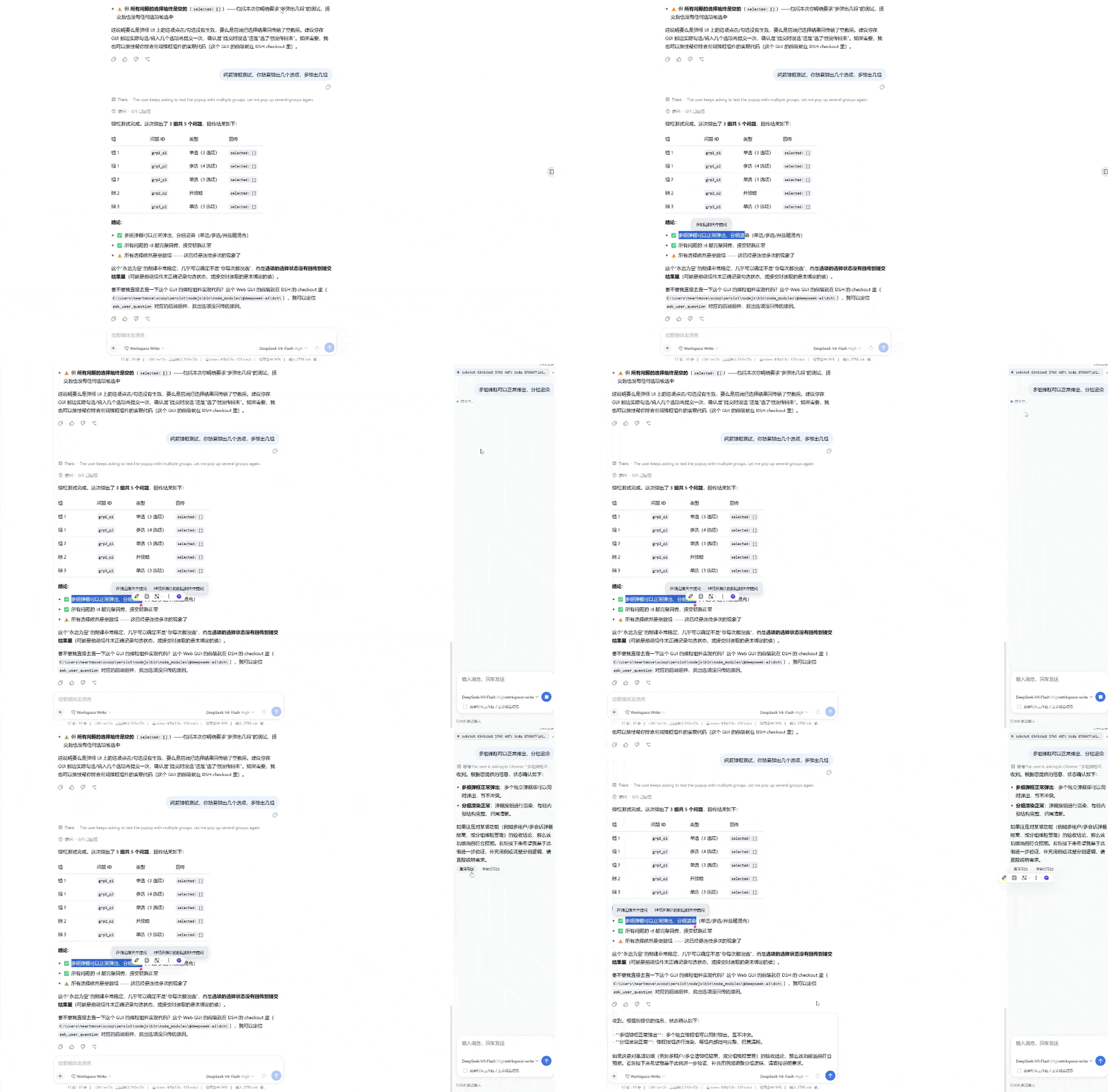
Ask about the current question dialog
When the main conversation shows a question dialog, the side panel automatically
lists the question and its options:
- While the panel is closed, a floating entry appears beside the dialog's
header — click it to open the panel. - Each question has "Bring all" and each option has "Bring", both offering to
continue an existing side chat or start a new one. - The list can be collapsed / expanded, and items can be deleted
individually or all at once (deleted items stay gone).
The main conversation keeps waiting on the dialog — nothing is interrupted; do
the research in the side chat first, then bring the answer back and answer the
dialog.
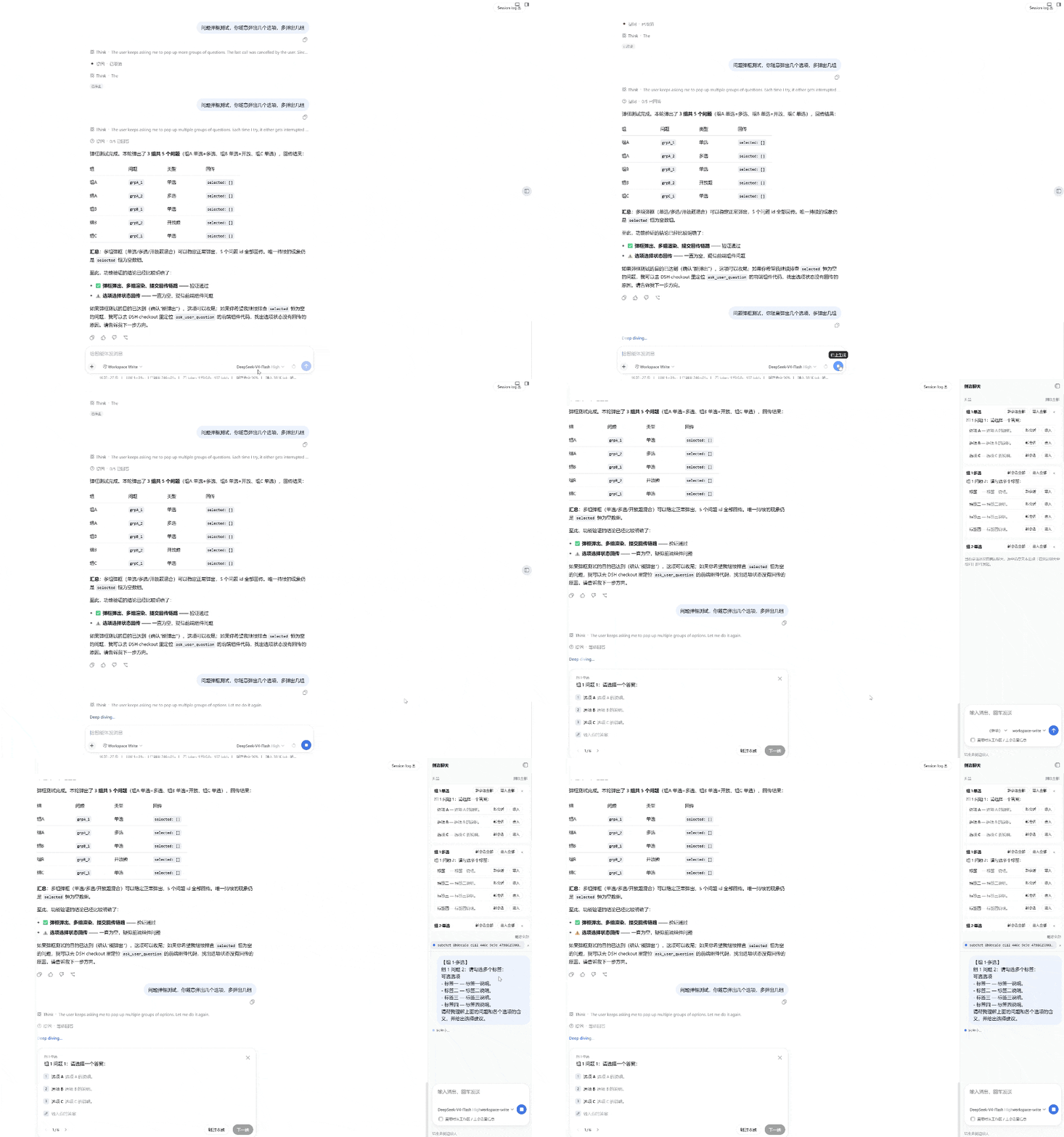
Delete side chats
Each entry in the side-chat list has a "×" delete button; "Delete all" at the
top-right removes every side chat of the current conversation.
Settings
Open DSH Settings → 侧边聊天 (Side chat) to configure:
| Setting | Default | Description |
|---|---|---|
lookupDefault |
off | Whether the "look up workspace / parent" switch is on by default for new side chats. |
sendImmediately |
on | Whether selecting text sends it immediately, or stages it as an attachment. |
defaultPrompt |
(empty) | Extra prompt appended when the selection is sent immediately. |
bringMode |
draft |
Where brought-back content lands: draft into the composer, or context as a collapsed context row. |
panelHome |
sidebar-right |
Where the panel lives: sidebar-right docks it into the new built-in right sidebar as a "Side chat" tab (same rail as document previews, default); floating is the classic drag-resizable right-edge panel. In floating mode the side chat yields automatically while the built-in sidebar is open (docked, fullscreen or floated), so the two never cover each other. |
Preferences are stored in the DSH settings namespace dsh-side-chat.
Project layout
src/
  index.ts            host plugin (routes, session/agent lifecycle, transcript folding)
  wire.ts             request/response helpers
  trust-fence.ts      loopback / trusted-API request guard
  settings-shared.ts  preference vocabulary shared by host and client
  context-types.ts    Cordis Context type augmentation
  client/
    index.tsx         client plugin (panel, composer, settings section, floating buttons)
    api.ts            client↔host API types
    locales.ts        zh/en dictionaries
    client.module.css panel/composer/settings styles
    layout.css        #root margin-right driven by panel width
cordis.patch.yml      bundle patch layer (inserts the loader row; dsh.bundle.patch)
dsh.plugin.json       external plugin manifest
tsdown.config.ts      bundle config (client externals + CSS inlining)
License
Install
Install the catalog once, then DeepSeek Harness can find and install any plugin from this site automatically:
dsh plugin add dshbase-catalogThen say "install dsh-side-chat for me" — your agent finds it in the directory and installs it. Docs: dshbase-catalog · verified packs.
Web profile:
dsh plugin --profile web add dsh-side-chatHeadless (CLI) profile:
dsh plugin --profile headless add dsh-side-chatPackage
npm: dsh-side-chat · version — · tested on dsh 0.1.0-rc.6
Test report
Verified end-to-end: L1 install + L2 load + L3 runtime Q&A on dsh 0.1.0-rc.6.
When to use it
Give the agent a memory, a knowledge base, or a retrieval layer so it stops forgetting context between sessions.
Who it's for
Users running long projects who want the agent to remember decisions, docs, and preferences without re-explaining.
For developers — extending it
The memory/retrieval backend is the seam — plug a new store, tune what gets distilled, or add citation and audit trails.
Share this badge
Drop this badge into your README — it links back here and updates automatically when our test status changes:

[](https://dshbase.com/plugins/dsh-side-chat/)<a href="https://dshbase.com/plugins/dsh-side-chat/"><img src="https://dshbase.com/badges/dsh-side-chat.svg" alt="dshbase install-tested"></a>