
Plugin directory / Developer / deepseek-harness-remote-ssh
deepseek-harness-remote-ssh
Verified · install-tested on dsh NaNQiQ
What it does
让 DeepSeek Harness(DSH) 使用原生工具直接操作远程 Linux 服务器,自由切换服务器
Works — verified, early-stage project
让 DeepSeek Harness(DSH) 使用原生工具直接操作远程 Linux 服务器,自由切换服务器 It installs cleanly and boots without issues in our testing. It's early-stage but functional.
“Verified” means our automated CI actually ran dsh plugin add in a clean profile and it booted — nothing more. Feature descriptions and version compatibility are the author’s claims. This is not a security audit and not an endorsement of third-party code.
README
DSH Remote SSH





Use the native DeepSeek Harness (DSH) tools directly on remote Linux servers.
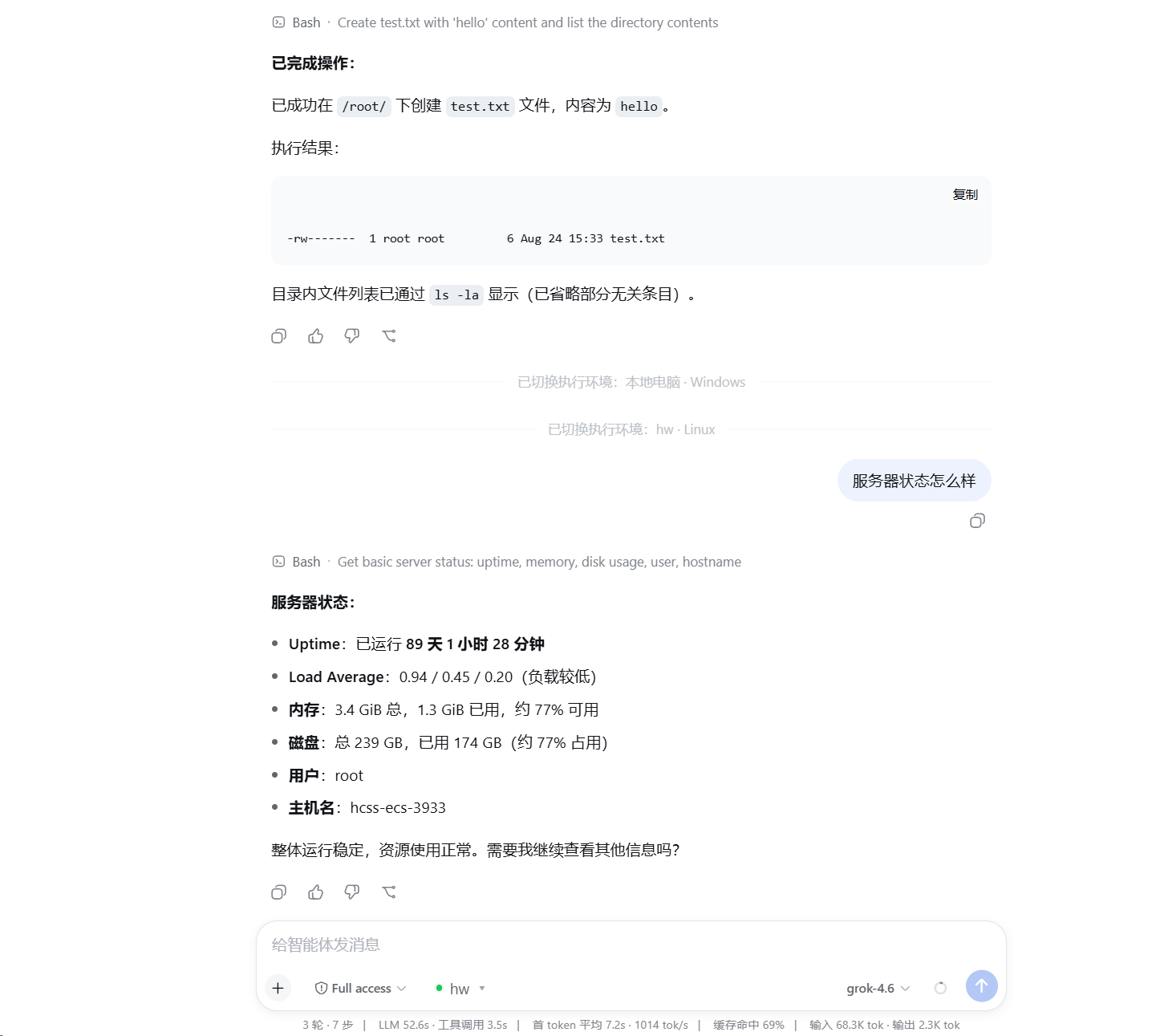
Select a saved server next to the conversation composer and DSH's existing read / write / edit / glob / grep / bash / terminal tools run remotely. The plugin does not modify DSH source code, and the server does not need DSH, this plugin, Node.js, or Python installed.
Features
- Add, test, manage, and select SSH servers inside the DSH Web UI.
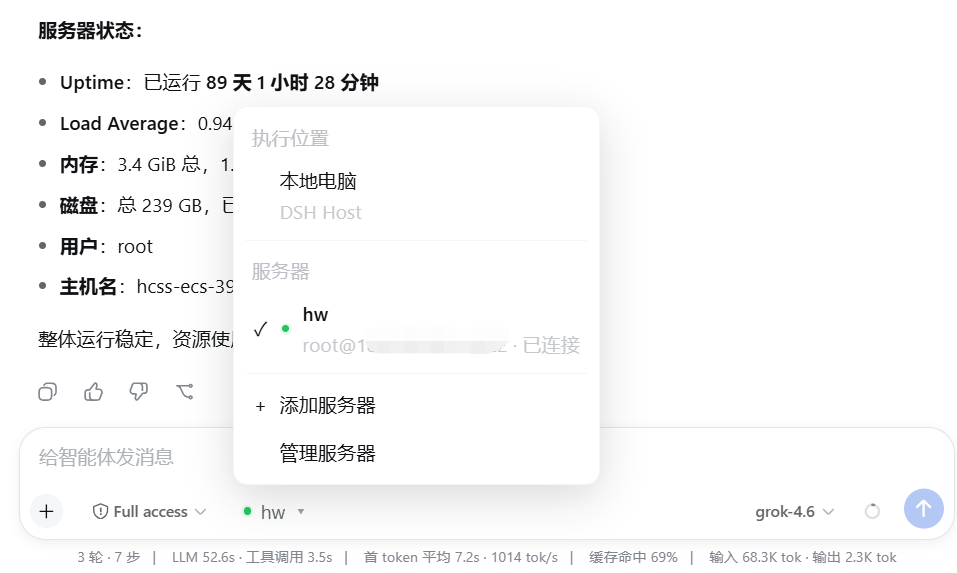
- Switch the execution environment between the local computer and saved servers.
- Keep the official DSH tools instead of adding reduced
ssh_*replacements. - Use SFTP for files, SSH exec / Shell for commands, and SSH PTY for interactive terminals.
- Preserve native
glob / grepbehavior while resolving and caching ripgrep for the remote Linux host. - Authenticate with SSH Agent, a private-key file, or a temporary password.
- Verify SSH Host Key fingerprints on first connection and reject unexpected changes.
- Reuse connections maintained by the DSH Host instead of logging in for every message.
Install
Requires Node.js 24 or newer, with dsh and pnpm available on PATH.
dsh plugin --profile web add github:NaNQiQ/deepseek-harness-remote-ssh
dsh web
If Windows cannot find pnpm, run npm install -g pnpm@11 in CMD and reopen CMD.
Use
- Start
dsh web. - Open the execution-environment selector next to the composer.
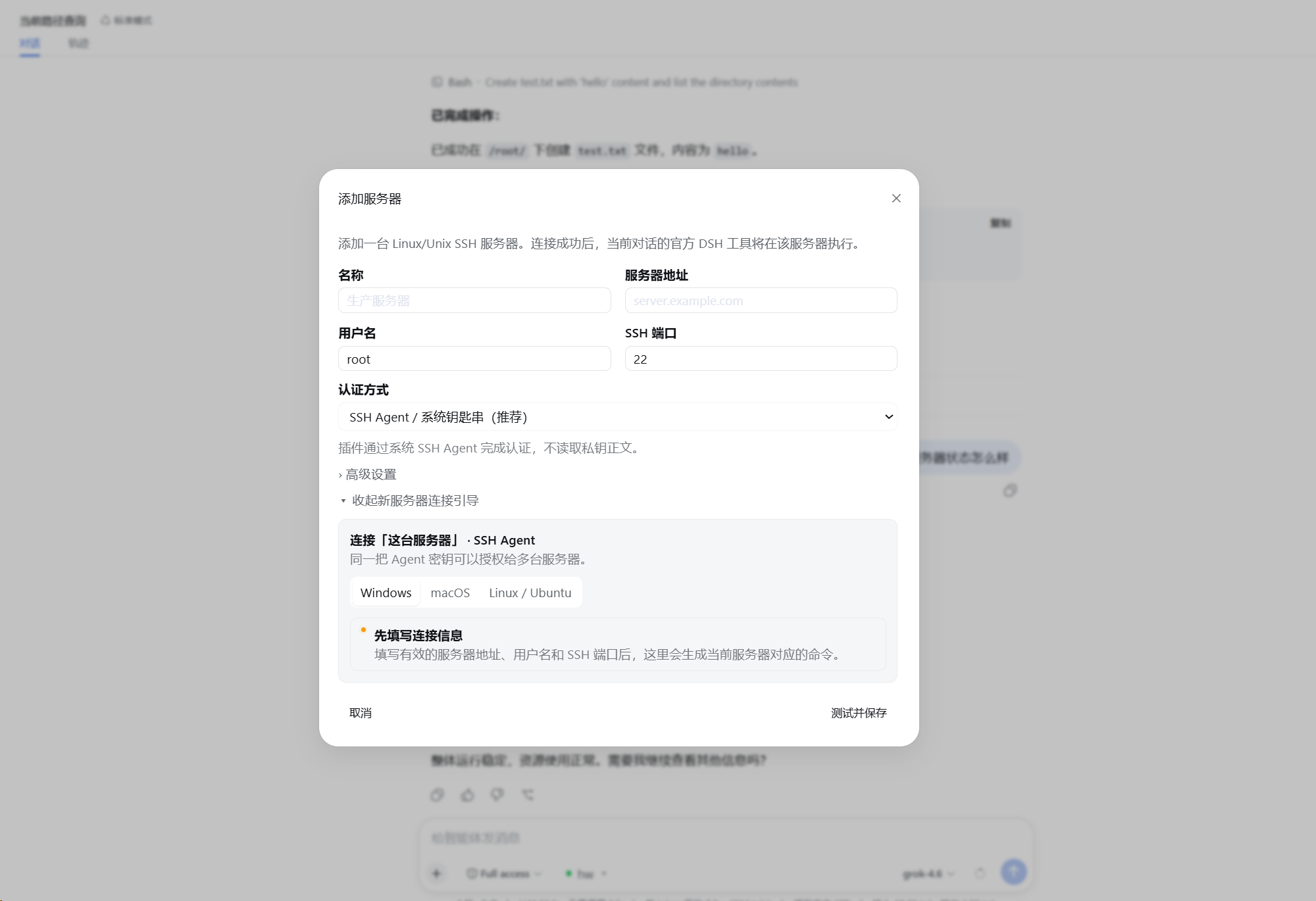
- Select Add server.
- Enter the connection, authentication, and default working-directory settings.
- Follow the built-in authentication guide and verify the server fingerprint.
- Select Test and save.
- Select the saved server next to the composer.
For later conversations, simply select the saved server. The model continues to use official DSH tools; only the location behind those tools changes.
Screenshots
Add and configure an SSH server
Switch between local and remote execution environments
Use native DSH tools on the remote server
Architecture
flowchart TB
    M[Model]
    T[Official DSH tools<br/>read · write · edit · glob · grep · bash · terminal]
    I[Official DSH execution interfaces<br/>ctx.fs · ctx.subprocess · ctx.shell · ctx.terminals]

    M --> T --> I

    subgraph W[Execution World]
        direction LR

        subgraph L[Local]
            LP[Native DSH providers]
            LOS[Local operating system]
            LP --> LOS
        end

        subgraph R[Remote SSH]
            RP[DSH Remote SSH providers]
            FS[SFTP<br/>remote filesystem]
            EX[SSH exec<br/>processes / shell]
            PTY[SSH PTY<br/>interactive terminal]
            RG[Official glob / grep arguments<br/>remote Linux ripgrep]

            RP --> FS
            RP --> EX
            RP --> PTY
            RP --> RG
        end
    end

    I --> LP
    I --> RP
Native DSH @ Linux
        ≈
DSH @ local computer + DSH Remote SSH → the same Linux host
The plugin changes where DSH executes, not how the model uses DSH tools. See ARCHITECTURE.md for implementation details.
Authentication
| Method | Behavior |
|---|---|
| SSH Agent | Requests signatures without reading private-key contents or enabling Agent Forwarding; suited to personal desktops |
| Private-key file | Persists only the path and reads the file when connecting; suited to dedicated accounts or server deployments |
| Temporary password | Kept only in current DSH Host process memory and must be entered again after restart |
Remote requirements and security boundary
- The target is a Linux / Unix host with SSH, SFTP, and a POSIX shell.
- Each server can define a default working directory; it is the initial
cwd, not a path sandbox. - Effective access equals the permissions of the remote SSH account.
- The Remote Provider does not expose the DSH Host's local filesystem to the remote execution world.
- Model API keys and Base URLs remain managed by DSH; this plugin does not read or store them.
See SECURITY.md for details.
Update and remove
dsh plugin --profile web update dsh-remote-ssh
dsh plugin --profile web remove dsh-remote-ssh
Restart DSH after updating or removing the plugin.
Documentation
- ARCHITECTURE.md — architecture and implementation
- SECURITY.md — security model and credential handling
- CHANGELOG.md — release history
- CONTRIBUTING.md — development and contributions
Related project
Friends

License
Install
Install the catalog once, then DeepSeek Harness can find and install any plugin from this site automatically:
dsh plugin add dshbase-catalogThen say "install deepseek-harness-remote-ssh for me" — your agent finds it in the directory and installs it. Docs: dshbase-catalog · verified packs.
This plugin is GitHub source (not published to npm) — install it straight from the repo:
Web profile:
dsh plugin --profile web add github:NaNQiQ/deepseek-harness-remote-sshHeadless (CLI) profile:
dsh plugin --profile headless add github:NaNQiQ/deepseek-harness-remote-sshTest report
Verified: L1 install + L2 load + L3 runtime from GitHub source on dsh 0.1.0-rc.6.
Share this badge
Drop this badge into your README — it links back here and updates automatically when our test status changes:

[](https://dshbase.com/plugins/deepseek-harness-remote-ssh/)<a href="https://dshbase.com/plugins/deepseek-harness-remote-ssh/"><img src="https://dshbase.com/badges/deepseek-harness-remote-ssh.svg" alt="dshbase install-tested"></a>