
Plugin directory / UI & Skins / dsh-navbar
dsh-navbar
Verified · install-tested on dsh vlln
What it does
A DSH plugin that adds a conversation-node navigation bar for quickly jumping between user messages.
Archived — no longer maintained, use with caution
This plugin has been archived and is no longer maintained — use it only if you're willing to maintain it yourself.
“Verified” means our automated CI actually ran dsh plugin add in a clean profile and it booted — nothing more. Feature descriptions and version compatibility are the author’s claims. This is not a security audit and not an endorsement of third-party code.
README
ARCHIVED (read-only) — The official DSH web shell shipped a built-in Turn navigation rail in the 0.1.2 series (npm
@deepseek-ai/dsh≥ 0.1.2-rc.1; upstreamfeat(ui-chat): full-session turn rail with load-and-jump, b3064cca): aTurnNavigatorrail with hover previews, click-to-jump, reading-position tracking, and jump-loads for unloaded turns. The core capabilities of this plugin are now covered by the host, so this repository is archived. Historical implementation remains indocs/and the git history.
中文 | English
navbar
Conversation node navigation rail: jump between user messages from the node strip on the right edge of the conversation — hover to preview, click to jump

An evenly spaced node strip along the right edge of the conversation area (one node per user message): the active pill follows your reading position, hovering shows a preview card (truncated at 6 lines), clicking smooth-scrolls with a brand-blue highlight ring, more than 30 nodes switch to a fixed 30-node window with count badges (↑N/N↓) at the ends showing how many are hidden, it stays invisible until hovered, and it auto-hides only when no user message is loaded — in that case it automatically loads earlier history until at least one user message appears (or history runs out). Implements the dsh-external/issues#144 spec. Form: an official bundle plugin (dsh.bundle + dshClient channel, browser-only, empty Node half), 0 patches.
Preview
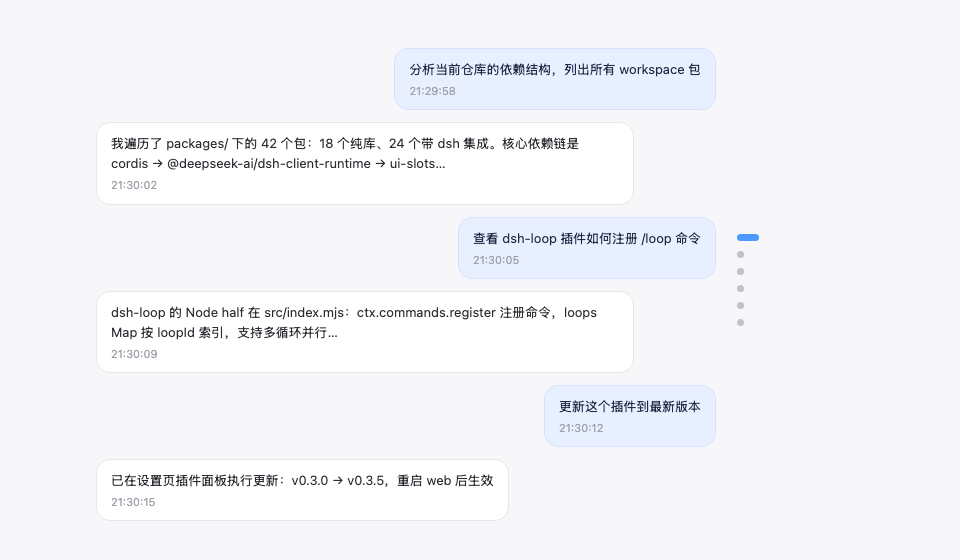
Features
| Feature | Description |
|---|---|
| Node navigation rail | Vertical node strip on the right edge of the conversation area, one dot node per user message |
| Follows reading position | The active pill (22px brand-blue capsule) moves with your current reading position |
| Hover preview | Hovering a node shows a message preview card (6-line truncation, matching the official HoverCard look) |
| Continuous hover | The entire rail (including the gaps between nodes) responds to hover continuously: the preview switches to the nearest node and the corresponding pill elongates (gray) to indicate the click target — no dead zones |
| Scroll-wheel switching | With the cursor over the rail, scrolling the wheel moves up/down one message (blocking conversation-area scrolling) |
| Click to jump | The whole rail is clickable (including gaps, jumping to the nearest node) plus an enlarged pill hit area — no need to precisely aim at tiny dots |
| Fixed window + count badges | More than 30 nodes show a fixed 30-node window (the active node stays centered, clamped at the ends); count badges (↑N / N↓) at the window ends show how many are hidden — the visible node count stays constant. Pinned golden discs always stay visible (the window expands to include them) |
| Load earlier history | An ↑ button pinned at the top of the rail (visible only while the conversation has older history): click to load earlier messages — it forwards to the official load-older control, so your reading position is preserved. Hovering it instantly shows a hint card in the same style as the node previews (the official HoverCard look) |
| Auto-hide | Not shown with no user message loaded (or on non-conversation pages). With zero user messages loaded, the rail automatically loads earlier history until at least one user message appears (or history is exhausted) — so the rail always has something to navigate |
| Message pin | 📌 button on the assistant action bar (between copy and Good response); pinned turns render as a golden slim elliptical disc in the rail (always visible, the preview card carries a 📌 badge, clicking jumps straight to the pinned reply), persisted per session |
Zero data-channel dependencies: driven only by official anchor attributes (data-time-hover-root, on user rows since 0806) — no polling, no routing, no tools.
Installation
Recommended: one-line install from git source (build artifacts are committed, so git source does not trigger a build):
dsh plugin --profile web add "github:vlln/dsh-navbar#main"   # one-line git-source install (build artifacts committed)
# or npm source: dsh plugin --profile web add @vlln/[email protected]
Or from a local directory (when you have the source): git clone, then cd dsh-navbar && dsh plugin --profile web add ..
Restart web after installing for it to take effect; you can disable/enable it in the Plugins panel on the Settings page.
Usage
Works out of the box — no commands, no tools. The node rail appears on the right edge of the conversation page (Chat view); hover for a preview, click to jump. Animations are disabled under prefers-reduced-motion.
Pin: hover an assistant message's action bar and click 📌 to pin that reply — the corresponding turn's navigation node becomes a golden slim elliptical disc (click to jump straight to that reply; the preview card shows a 📌 badge and the reply text). Pin state is saved per session in browser localStorage and survives refreshes; click again to unpin.
Load earlier history: when the open conversation still has older messages (its history window is not fully loaded), an ↑ button sits at the very top of the node rail. Click it to load the earlier messages — the rail then grows new nodes at the top. The button hides automatically once all history is loaded, and is disabled while a load is in flight. Hovering it instantly shows a hint card in the same style as the node previews (the official HoverCard look), and it reads "Loading…" while a load is in flight. The click is forwarded to the official load-older control, so your current reading position is preserved (no content jump).
Development
pnpm install
pnpm run build      # tsdown: client bundle (lib/client.js)
- client:
src/client/index.ts(self-rendered DOM + official anchor contract; the pin button uses the officialconversation.chat.assistant-actionsslot, with React provided by the client runtime; ctx services accessed must be declared in the plugin object'sinject) - Node half:
src/index.mjs(empty apply, the bundle mount carrier)
License
MIT License (an example plugin in the DSH ecosystem).
Install
Install the catalog once, then DeepSeek Harness can find and install any plugin from this site automatically:
dsh plugin add dshbase-catalogThen say "install dsh-navbar for me" — your agent finds it in the directory and installs it. Docs: dshbase-catalog · verified packs.
This plugin is GitHub source (not published to npm) — install it straight from the repo:
Web profile:
dsh plugin --profile web add github:vlln/dsh-navbarHeadless (CLI) profile:
dsh plugin --profile headless add github:vlln/dsh-navbarTest report
Verified: L1 install + L2 load + L3 runtime from GitHub source on dsh 0.1.0-rc.6.
When to use it
Change how dsh looks or how you interact with it — a theme, a skin, or a new panel that reshapes the workspace.
Who it's for
Users who spend hours in the web UI and want it to look and feel the way they work.
For developers — extending it
Skins, panels, and theme tokens are the extension points — author a new skin, add a panel, or sync tokens with an upstream palette.
Share this badge
Drop this badge into your README — it links back here and updates automatically when our test status changes:

[](https://dshbase.com/plugins/dsh-navbar/)<a href="https://dshbase.com/plugins/dsh-navbar/"><img src="https://dshbase.com/badges/dsh-navbar.svg" alt="dshbase install-tested"></a>